Finance at a fast-growing company faces a specific challenge that the AI adoption roadmap designed for established businesses does not fully address: the underlying workflows, team structure, and technology are all changing simultaneously. The process that makes sense for a 50-person company with $8M in revenue is wrong for the same company 18 months later with 150 people and $30M in revenue.
This creates a sequencing problem. Automate a workflow before it is stable and the automation becomes a maintenance burden every time the workflow changes. Wait too long and the manual process that worked at $8M creates control gaps, close delays, and cash flow uncertainty at $30M. The CFO or VP of Finance at a fast-growing company needs a framework for deciding what to automate now, what to do manually but systematically, and what to wait on until the underlying process is more settled.
The Stability Test for Automation Decisions
Before automating any finance workflow, ask two questions. First: how likely is this workflow to change materially in the next 12 months? Second: how much time does the current manual process cost relative to the implementation and maintenance cost of automation?
Workflows that score high on both stability and manual cost are the clear automation priorities. Workflows that are highly likely to change in the next 12 months, because the business model is evolving, because the team structure is in flux, or because the company is about to change its ERP, should wait. Automating them now creates a rebuild project in 12 months rather than value.
What to Automate Early (Stable, High Volume)
Invoice capture and AP processing
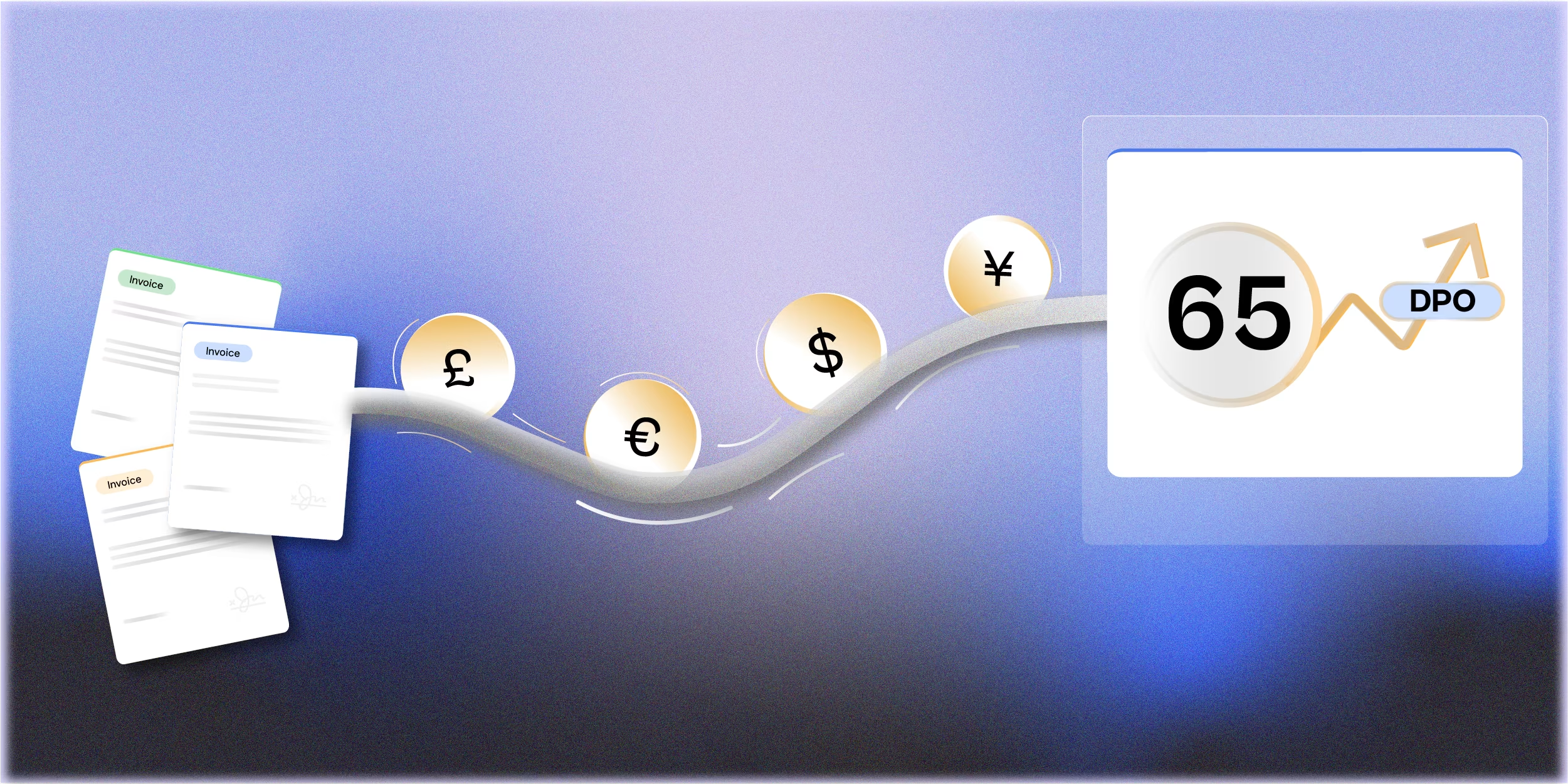
AP invoice processing is one of the most stable workflows in any company. The mechanics of capturing an invoice, matching it to a purchase order, getting approval, and paying the supplier do not change materially as the company grows, even though the volume increases significantly. Automating AP early captures efficiency gains that compound as volume grows. The investment in vendor master setup and ERP integration pays back faster at growing volume.
Bank reconciliation
Bank reconciliation is another stable, high-volume workflow. The mechanics do not change with company size. The volume increases. Automated bank feed reconciliation that matches transactions to ledger entries and surfaces exceptions daily is worth implementing early because it produces daily cash visibility that fast-growing companies need for working capital management.
Expense report processing
T&E expense processing follows a consistent structure regardless of company size. The policy may evolve, but the workflow of capturing receipts, checking against policy, and reimbursing employees is a candidate for automation once the policy is defined and stable. Expense automation that enforces policy consistently as headcount grows prevents the policy drift that occurs when manual review cannot keep up with submission volume.
Recurring journal entries
Depreciation, prepaid amortization, accrued payroll, and rent are recurring entries that follow a predictable template every period. Automating these entries early reduces the close cycle time and frees the accounting team from routine posting work that adds no judgment value.
What to Do Manually but Systematically (Stable, Lower Volume)
Chart of accounts and cost center structure
The chart of accounts should be designed carefully and maintained consistently, but it should not be heavily automated until it is stable. Fast-growing companies redesign their chart of accounts when they raise a new funding round, add a new business line, or restructure their management reporting. Implementing automation that depends on a specific account structure before the structure is settled creates rework when the structure changes.
The right approach is to design the chart of accounts with future scale in mind, allocating account number ranges for categories that do not exist yet, maintaining a single owner for account additions, and to document it carefully without automating the maintenance workflow until the structure has been stable for two full fiscal years.
Management reporting
Management accounts at a fast-growing company often change in structure as the business's reporting needs evolve. The metrics that matter at $10M are different from those at $50M. The department-level breakdown that made sense at 50 people does not reflect the organizational structure at 200. Investing in a fully automated management pack that depends on a specific structure before that structure is settled creates an automation debt rather than an efficiency gain.
The right approach is to standardize the management accounts structure deliberately and maintain it consistently for at least two to three quarters before automating the production. Once the structure is stable, the automation investment pays back quickly.
What to Wait On (Unstable or Low Volume)
Revenue recognition automation
Revenue recognition rules often evolve as a fast-growing company's business model evolves. A company that starts with simple one-time sales may add subscriptions, then professional services, then usage-based pricing. Each model has different recognition rules. Automating revenue recognition before the revenue model is settled requires rebuilding the automation every time the model changes. Manual revenue recognition with consistent application of the relevant standard is less risky until the revenue model is stable.
Multi-entity consolidation
Companies that are adding entities through acquisition or international expansion should wait to automate the full consolidation workflow until the entity structure is reasonably settled. A consolidation automation built for three entities that needs to be rebuilt for six entities 18 months later was premature. Design the consolidation process to be automatable from the start, but implement the automation once the entity structure is clear.
Complex FP&A driver models
Fully automated driver-based planning models require a stable driver structure to function reliably. At a fast-growing company where the key revenue and cost drivers are still being identified and refined, investing in a sophisticated automated model before the driver structure is understood produces a model that needs constant manual intervention to stay connected to reality. Start with a simpler model that can be understood and updated by any competent finance professional, and automate the mechanics once the driver logic is well understood.
The Minimum Finance Infrastructure Checklist
Regardless of automation decisions, a fast-growing company's finance function needs these foundations in place before scaling:
- An ERP that the company will not need to replace before $100M in revenue, the single most expensive infrastructure mistake is implementing a system that needs to be replaced at $30M
- A chart of accounts designed for the business at its eventual scale, not just its current size
- A close process with a defined checklist, clear task ownership, and a target close day that is enforced
- A cash flow view that is updated weekly, even if it is manual, the company cannot manage cash it cannot see
Start Here
List every manual finance process that takes more than 4 hours per month. For each one, assess stability: how likely is the underlying workflow to change materially in the next 12 months? Prioritize the high-time, high-stability items for automation. Put the high-time, low-stability items on a watch list to automate after the workflow settles. This simple prioritization prevents the most common automation mistake at fast-growing companies: investing in automation that needs to be rebuilt 12 months later.