Financial consolidation is the step that turns the books of individual legal entities into a single group financial statement. Every entity closes its own accounts. Then someone, usually a group controller or consolidation accountant, assembles those individual results into a consolidated P&L, consolidated balance sheet, and consolidated cash flow statement that eliminates intercompany transactions, applies foreign currency translation at the correct rates, and allocates minority interests correctly.
For a business with three entities in the same currency, this is manageable manually. For a business with eight entities across four currencies and two minority-owned subsidiaries, it is a multi-day process that is the primary reason the group close takes two weeks instead of five days.
AI does not change the accounting rules that govern consolidation. It changes how long the data assembly, reconciliation, and translation steps take, which is where most of the time goes.
Where the Time Goes in Manual Consolidation
- Waiting for entity submissions to arrive, chasing laggards, and confirming that the trial balance figures submitted match what is posted in the entity ERP
- Identifying and eliminating intercompany transactions, which requires matching entries across entity pairs that may use different account codes and different transaction descriptions for the same underlying event
- Applying foreign currency translation, translating income statement items at average rates, balance sheet items at closing rates, and computing the cumulative translation adjustment that goes to equity
- Calculating minority interest allocations for partially owned subsidiaries across both profit and loss and the balance sheet
- Reconciling the consolidated retained earnings to the sum of entity retained earnings after all adjustments
- Preparing segment reporting that cuts the consolidated results a different way from the legal entity structure
Each of these steps is technically well-defined. The complexity is not conceptual. It is operational: the data is in different places, in different formats, with different reference codes, and it needs to be brought together and transformed correctly under time pressure.
What AI Addresses in the Consolidation Workflow
Automated entity trial balance ingestion
AI connects to each entity ERP or reporting system and ingests trial balance data as it is posted rather than waiting for a manual export and submission. The group consolidation system has current entity data without requiring anyone to extract, format, and submit a file. When an entity posts a late adjustment, the consolidated view updates automatically.
The validation step, confirming that the entity submission ties back to the posted trial balance, runs automatically at ingestion rather than manually before the consolidation is assembled. Submission errors surface immediately rather than after the group controller has spent two hours building on incorrect entity data.
Intercompany elimination matching
AI matches intercompany balances across entity pairs using the logic described in the intercompany reconciliation article: fuzzy matching on amounts, dates, and transaction descriptions across entity accounts that may not use the same coding. Clean matches are eliminated automatically. Mismatches above a defined threshold are flagged for review.
The improvement in consolidation is the same as in intercompany reconciliation but applied at the group reporting level rather than the operational level. Instead of the group controller manually comparing Entity A's receivable from Entity B against Entity B's payable to Entity A, the system does it and surfaces only the genuinely disputed items.
Currency translation automation
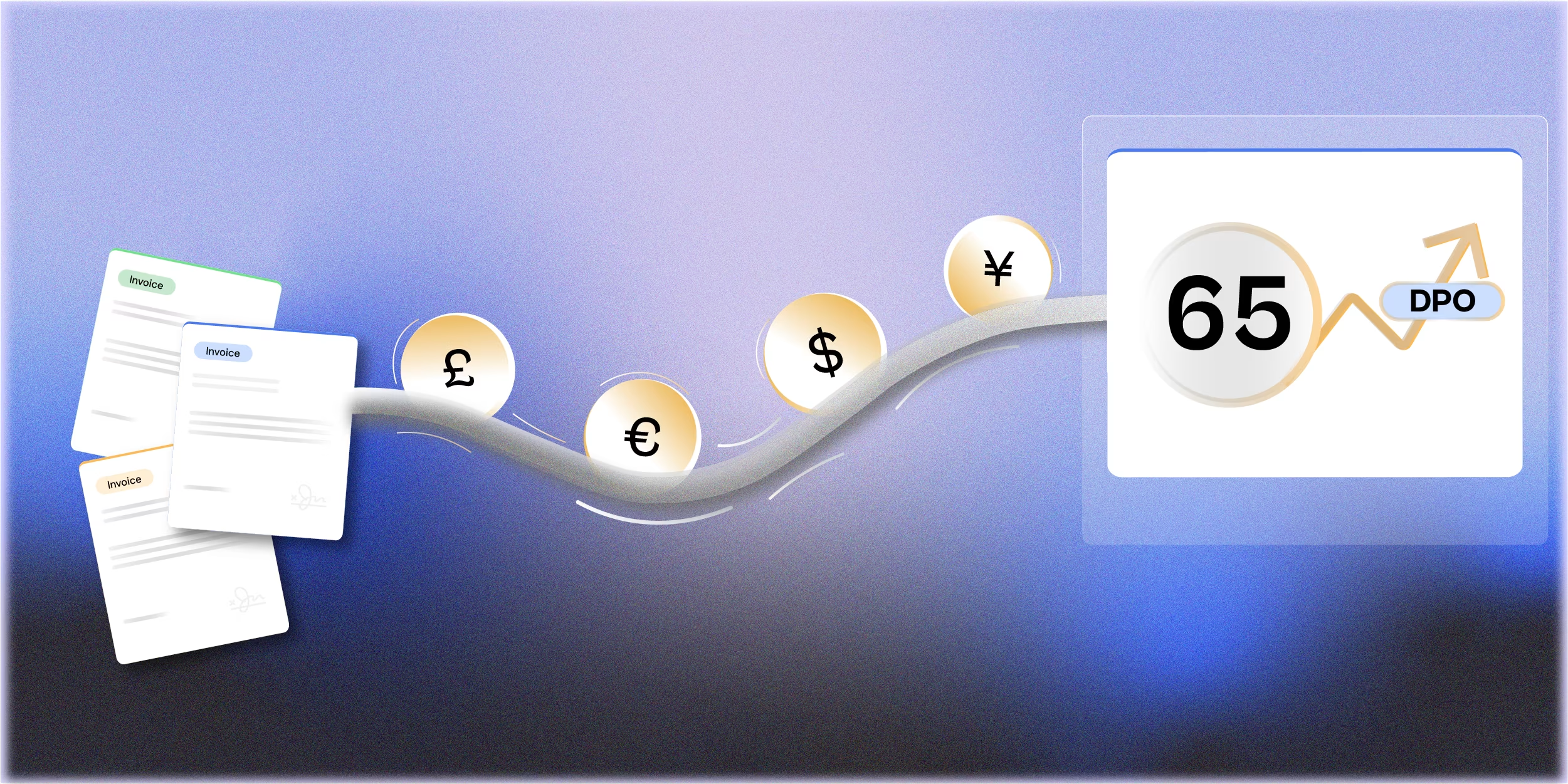
The foreign currency translation calculation is rule-defined but data-intensive. AI applies the correct rate to each account category automatically: average rate for income statement items, period-end rate for monetary balance sheet items, historical rate for non-monetary items. The cumulative translation adjustment is calculated and posted to the equity section without manual rate application.
Rate data is ingested from the treasury system or an exchange rate feed automatically. The controller reviews the translation output rather than building it. For a group with four foreign currency entities, this compression is typically worth a full day of close cycle time.
Minority interest calculation
AI applies the minority interest percentage to the subsidiary's profit and loss and net assets based on the ownership structure recorded in the consolidation system. When ownership percentages change during the year, due to an acquisition tranche, an option exercise, or a partial disposal, the system recalculates the allocation based on the updated structure without requiring a manual rebuild.
Consolidated working paper generation
AI assembles the consolidation working paper, the document that shows how each line in the consolidated financial statements was derived from entity submissions plus adjustments, automatically as each step is completed. The working paper is audit ready without a separate documentation effort. When an auditor asks how the consolidated revenue was derived, the answer is in the working paper rather than requiring reconstruction.
What the Group Controller Still Owns
- Judgment on accounting treatment for consolidated adjustments that do not arise from entity-level data: acquisition accounting entries, goodwill impairment assessments, group-level provisions
- Review and sign-off on the intercompany elimination exceptions that AI has flagged as genuine mismatches rather than timing differences
- Segment reporting design decisions: how to cut the consolidated results by segment, geography, or product line requires a deliberate mapping exercise that cannot be automated without clear policy decisions already made
- The consolidation narrative for management and board reporting: what the group results mean, what changed versus prior period, what the forward implications are
The Close Cycle Impact
Manual consolidation in a multi-entity group typically absorbs days three through nine of a ten day close cycle. AI-assisted consolidation with automated ingestion, intercompany matching, and currency translation compresses this to days three through five or six. The group controller uses the final days for review and narrative rather than for assembly and reconciliation.
The entities that previously submitted last because they knew the group controller was still waiting for other submissions can now submit in parallel. There is no queue. The consolidation updates as each entity submits and the group controller can see the consolidated picture building in real time rather than waiting for all submissions to arrive before starting the assembly.
Start Here
Measure where consolidation time currently goes across the last three close cycles. Break it into the components: waiting for submissions, intercompany reconciliation, currency translation, minority interest, and working paper preparation. The component with the largest time allocation is the consolidation automation priority. For most mid-market groups it is either intercompany reconciliation or currency translation, and both are well-suited to AI automation as first steps.