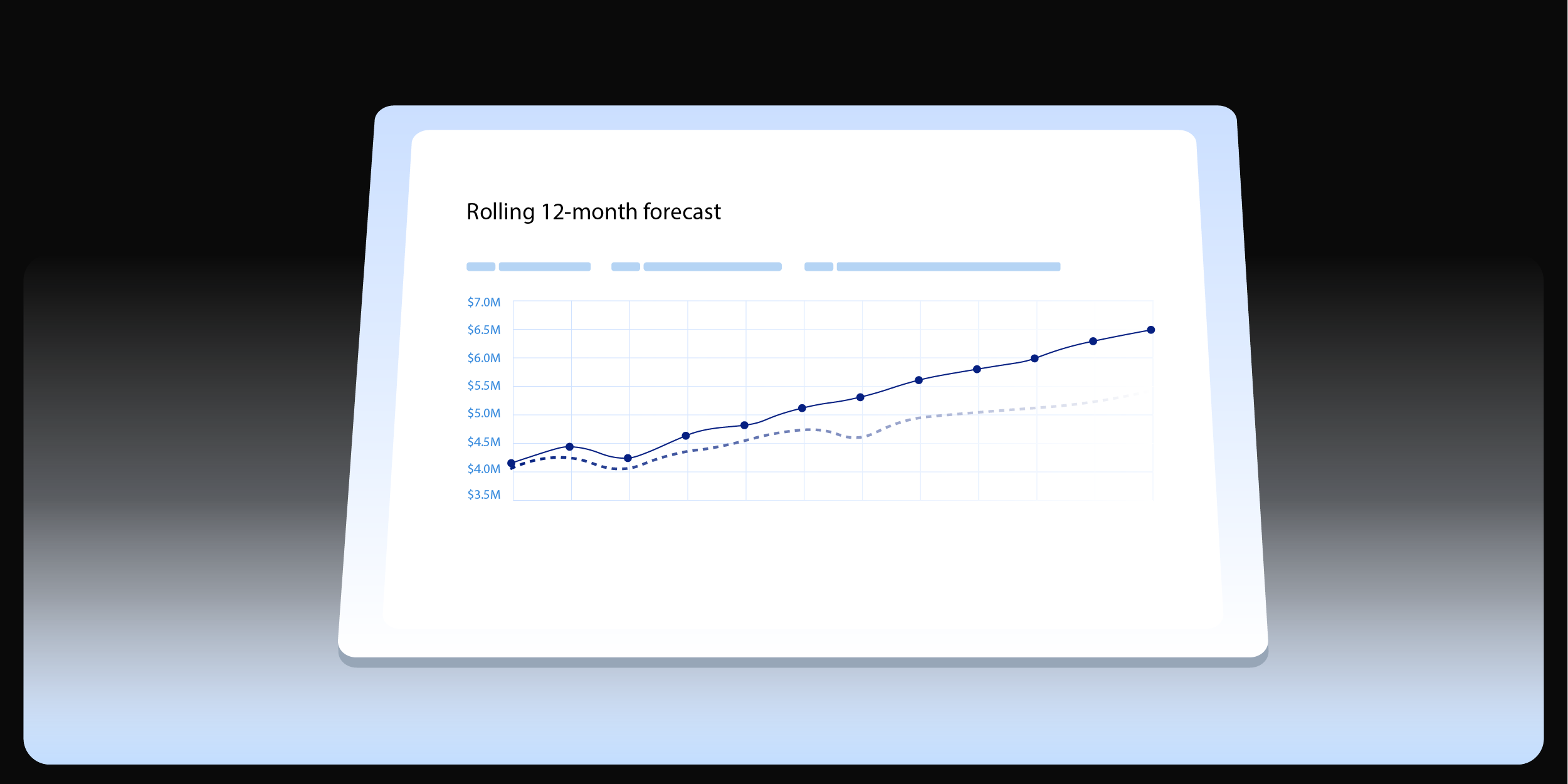
The case for rolling forecasts over annual budgets is well established. A rolling 12-month or 18-month forecast that updates each period reflects current business reality better than a budget fixed in October that becomes increasingly irrelevant by February.
The reason most finance teams do not maintain rolling forecasts is not philosophical disagreement, it is resource constraint. A true rolling forecast requires rebuilding the full model every month: updating actuals, refreshing driver assumptions, extending the horizon by one period, and re-running all scenarios. For FP&A teams already stretched by the close cycle, that rebuild is not feasible.
AI changes the economics of rolling forecasting. The data assembly, driver updates, and period extension that make the monthly rebuild expensive can be largely automated. What remains is the judgment layer: reviewing the updated forecast, challenging assumptions that have drifted from business reality, and communicating the changes to management.
The Difference Between a Rolling Forecast and a Budget Reforecast
These terms are often used interchangeably but describe different things. A budget reforecast is a periodically revised version of the annual budget, typically done quarterly. It still anchors to the original budget year and compares actuals to the original plan.
A rolling forecast maintains a fixed forward horizon, typically 12 or 18 months that extends forward each period. January's rolling forecast covers February through January of next year. February's rolling forecast covers March through February of next year. There is no fixed year-end. The focus is always on the next 12 to 18 months of the business.
Rolling forecasts are better decision-support tools. They are also significantly harder to maintain manually.
What Makes the Monthly Rolling Forecast Rebuild Expensive
- Ingesting new actuals and reconciling them to the forecast requires a manual export, import, and variance review
- Driver assumptions need to be reviewed and updated where business conditions have changed
- The new forward period needs to be populated either by extending a formula or by manually building out the new month
- Scenarios need to be re-run with updated base assumptions
- The management commentary needs to reflect what changed and why
For a model covering five entities, four departments, and twelve revenue lines, this process takes two to three days each month. That is an unaffordable overhead for most finance teams, which is why most rolling forecast implementations quietly revert to quarterly reforecasts within a year.
Where AI Automates the Rolling Forecast Rebuild
Automatic Actuals Ingestion
AI connects to the ERP and pulls current-period actuals as they post during the close cycle. By close day three, actuals for the completed period replace the prior forecast for that period automatically. The FP&A team reviews rather than rebuilds.
Driver-Based Forward Projection
AI extends the rolling horizon automatically using the defined driver structure. The new forward month inherits the current driver assumptions like revenue growth rate, headcount trajectory, cost inflation factors and generates a projection. The analyst reviews and adjusts where business conditions have changed, rather than building the new period from scratch.
Assumption Change Detection
AI compares current driver assumptions against prior-period assumptions and flags significant changes. If the revenue growth rate used in last month's forecast was 12% and the model now implies 9% based on current pipeline data, AI surfaces that change for FP&A review. Assumption drift becomes visible rather than invisible.
Scenario Refresh
Defined scenarios like base, upside, downside re-run automatically against the updated base assumptions each period. The scenario range updates without requiring FP&A to rebuild each scenario manually. When the base forecast changes, the scenarios reflect those changes immediately.
The FP&A Time Allocation That Becomes Possible
In a manual rolling forecast, FP&A spends roughly 60% of their monthly cycle time on the rebuild mechanics and 40% on interpretation and communication. With AI-assisted rolling forecasts, that ratio inverts:
- Actuals ingestion and period extension: automated
- Driver assumption review: one to two hours of focused analyst time per period
- Scenario refresh: automated, reviewed rather than rebuilt
- Management commentary: FP&A time focused on explaining what changed and why, with AI generating first-draft explanations for the largest variance-to-prior-forecast items
The output: a rolling forecast that is genuinely current, maintained with sustainable FP&A effort, and supported by management commentary that is ready before the senior team asks for it.
What AI Cannot Determine in a Rolling Forecast
- When assumptions should change. AI flags that the revenue growth rate implied by current pipeline data has dropped. The FP&A analyst decides whether to update the assumption, challenge the pipeline data, or hold the rate because management has specific commercial conviction about the next quarter.
- Strategic plan alignment. A rolling forecast should reflect both current business trajectory and strategic intent. Reconciling those two when they diverge is a leadership conversation, not a model update.
- What to communicate to management. The changes in the rolling forecast between periods tell a story about how the business is performing against expectations. That story — what changed, why it matters, and what it implies for decisions is written by FP&A, not generated by AI.
Implementing Rolling Forecasts: Prerequisites
- A driver-based model structure. Rolling forecasts require models built on explicit driver assumptions, not hardcoded monthly inputs. If the forecast model is a collection of manual entries, AI cannot extend it automatically.
- Clean ERP data. Actuals ingestion requires ERP data that posts consistently and is coded correctly. The data quality work from Article 21 is a direct prerequisite.
- Defined assumption ownership. Each driver assumption needs an owner who reviews and updates it. Without clear ownership, driver assumptions drift without anyone being accountable.
Start Here
Start with one entity and a simplified driver structure: revenue by major category, headcount, and the top five operating cost lines. Build a 12-month rolling model with three to five drivers. Run the AI actuals ingestion and forward extension for one complete quarter.
The discipline of maintaining the rolling model for a single quarter like reviewing driver assumptions monthly, updating the horizon, generating scenarios tells you whether the model structure and data connections are robust enough to scale. A rolling forecast that works for one entity with confidence is the foundation for extending to the full business.