An owner at a construction trades SMB described the week without software poetry. Literally a PO book. People call in and give a PO number. Invoices arrive. Someone matches. Someone chases POs. Someone chases invoices. The bookkeeper added the coding twist: one vendor maps to multiple classes, so it is never a simple one-to-one.
The aha was tangible. Cost savings because you are getting rid of PO books. Relief for the owner who had become the chase function.
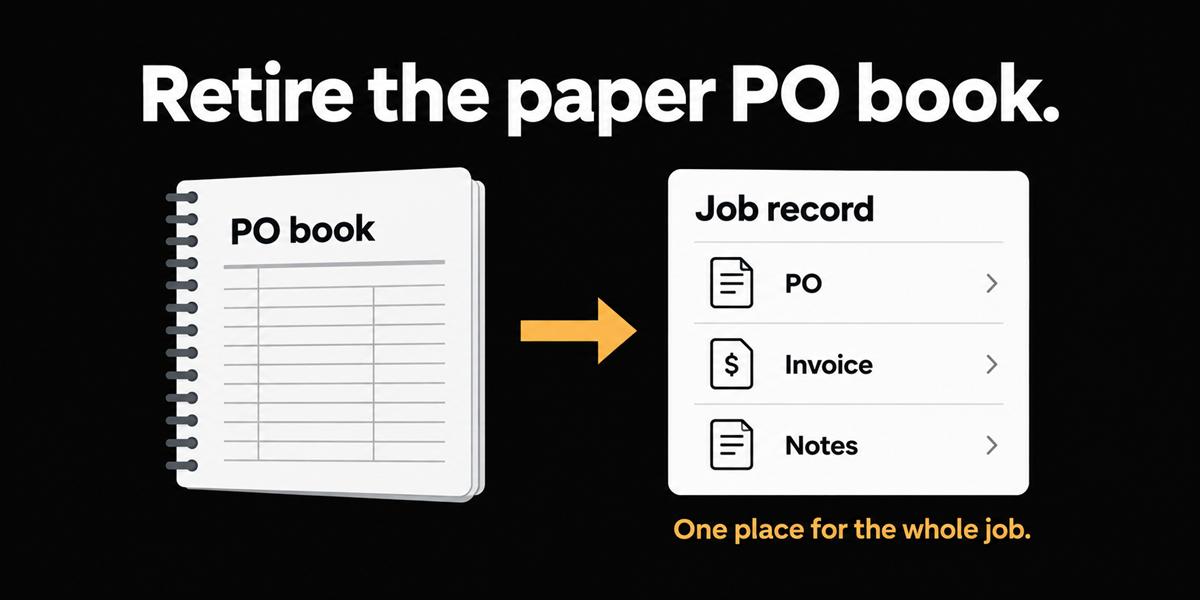
The direct answer: put the digital PO, the invoice, and the notes in one object so matching is not a scavenger hunt across paper, phones, and email. Paperless retention is the side effect. The main effect is that the owner stops being the routing layer.
This matters most if you are a Canadian trades or construction SMB still using physical PO books, if phone-in PO numbers are normal, and if the owner or working manager is the person who knows where everything is.
Process wow beats AI wow here
This audience does not need a lecture on machine learning. They need the book to go away without losing control. The second problem after buying an "AI AP" tool is discovering that coding rules for the same vendor across jobs still need thought. Eliminating the book is necessary. It is not sufficient.
CRA expectations sit in the background. Canadian businesses generally must keep books and records for six years from the end of the last tax year they relate to (CRA keeping-records guidance; Income Tax Act record framework). Cardboard boxes can meet retention poorly and retrieval poorly at the same time.
Numbers that keep the story honest
Ardent Partners' average $9.40 cost to process an invoice and 32.6 percent touchless rate (Metrics That Matter in 2025) describe a broader market. An SMB with phone-in POs is not failing a touchless benchmark. It is paying in owner hours.
GBTA-style expense figures are the wrong analogy. Use a local measure: hours the owner spends chasing documents in a week, and how often a job cannot close because a PO page is in a truck.
Owner relief checklist
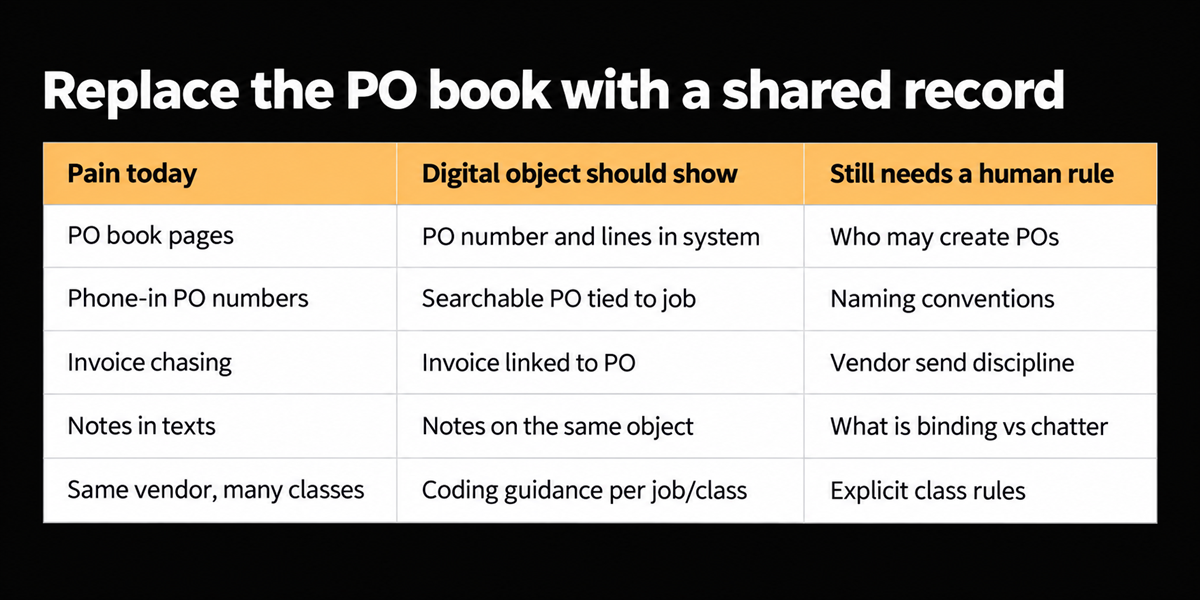
If the right-hand column is empty in your plan, you will recreate the book inside a folder tree.
What we built
Digital PO creation and visibility, invoice matching against those POs, and a single place for notes so the chase path shortens. Document retention becomes a system property instead of a box in the site office. Buyers responded to cleanliness more than to model names.
We refused to pretend AI invents job coding when one vendor serves many classes. That still needs rules or disciplined PO coding so invoices inherit the job.
Who this applies to
This matters most if paper or spreadsheet PO books still sit with an owner or project lead and AP chases signatures after the work is done.
Where this does not help
Same vendor to multiple classes remains a coding design problem. Getting rid of PO books does not choose the class for you.
If your crews will not adopt any digital PO step, you will recreate phone notes. The product can hold the object. Behaviour still matters.
Deliberate choice: process cleanliness over AI spectacle for this segment. We would rather remove a physical book than demo a flashy feature crews ignore.
Back to the truck and the book
The book lived because it was simple. Replace it with something equally findable: one object with the PO, the invoice, and the notes. Let the owner build again instead of chase.
Cleanliness is the feature
In the demo, the owner did not praise a model. They praised the idea that POs come out of the system and that the chase load lifts. For SMB trades, cleanliness is the differentiator. If your evaluation scorecard only scores AI buzzwords, you will buy something crews will not touch and the book will stay in the truck.
Retention without romance
Owners asked where documents live for CRA timelines. That is the right question. Seven-year habits show up in conversation even when the statute language centres on six years from tax year end in common guidance. Align with your accountant, then make retrieval part of the design: find by vendor, job, PO, date. A box can hold paper for years and still fail an audit request that needs one invoice this afternoon.
Phone-in PO numbers can stay. The book does not have to.
Crews will still call numbers in. That behaviour can survive. What should not survive is the only copy living on paper. When the number is issued from the system, the call references a real object. Matching stops depending on who has the pad in their truck.
Bookkeeper and owner need the same screen
When the owner chases and the bookkeeper codes, two screens recreate the paper split. One object with PO, invoice, notes, and coding draft lets them argue on facts instead of on whose turn it is to call the supplier.
Class coding still needs a deliberate rule
When one vendor serves multiple classes or jobs, the digital PO should carry the class or job code so the invoice can inherit it. If the PO is blank, the bookkeeper is back to guessing. Eliminating paper without encoding job identity just moves the guess into software. Make the create-PO step force the job field if that is how your P&L works.
What "chase" means in hours
Ask the owner to estimate weekly hours spent chasing POs, invoices, and receipts. Write the number down. After a digital PO pilot on one crew, estimate again. Even without a polished ROI model, the direction tells you whether the book was the bottleneck or whether coding rules remain the bottleneck.
Start with one crew
Do not digitize every truck on day one. Pick one crew, issue POs digitally for two weeks, and keep a paper backup only as fallback. Review miss rate, chase hours, and coding errors. Expand when the object is trusted. Big-bang paper abolition creates underground pads.
Cost savings without invented ROI
Owners sensed cost savings from retiring PO books. We will not invent a percentage. Measure your own: book purchase and printing cost is trivial; owner hours and delayed job close are not. Use hours and cycle time, not a vendor ROI calculator.
Notes are part of the audit pack
Texts between owner and supplier often contain the real agreement. If notes stay in personal phones, the digital PO is incomplete. Put binding clarifications on the object. Leave chatter out. Teach the difference once so the object stays readable.
Frequently asked questions
Do we still need paper for CRA?
You need accessible records for the retention period. Digital records can qualify when they remain readable and complete. Confirm your accountant's preference for your situation.
What about change orders?
They need a home on the same job object. A new paper page in a new book is how drift returns.