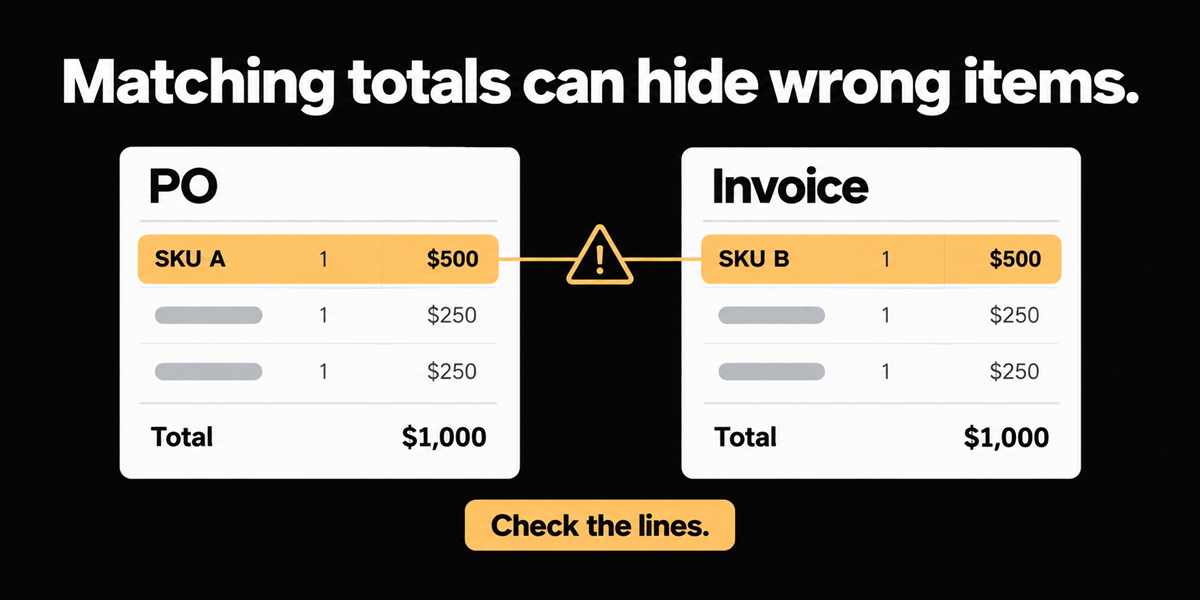
A drywall and light manufacturing group with multiple legal entities runs purchase orders through a manufacturing system and books payables in QuickBooks. The AP clerk opens an invoice that totals to the PO. The header match is green. Then someone reads the lines: three SKUs, one pack size that does not match the PO unit, and a price that drifted after the last price list landed. The total still ties. The inventory and the books do not.
Header match is not line match. If your auto match only compares invoice total to PO total, it will approve documents that are wrong on every line that matters for receiving, costing, and vendor kickbacks.
This matters most if you buy the same materials across jobs or plants, if vendors invoice in different units than you purchase (sheets versus pounds, cases versus eaches), and if price lists move after POs are cut.
Why a matching total still leaves work on the desk
Manufacturing and materials buyers already know the failure mode. An incumbent or ERP matcher clears the invoice because the dollars equal the dollars. Nobody on that screen asked whether SKU A on the invoice is the same item as line 4 on the PO, whether forty sheets equals the poundage the mill billed, or whether the unit price is the PO price or the newer, lower list price the vendor emailed last Tuesday.
We have heard that ask in plain language from operations and finance on the same call: can matching cross reference item by item, not only total to total. Separately, metals and specialty materials teams describe the poundage edge: the PO is in one unit, the invoice arrives in another, and someone edits by hand so the receipt and the bill agree.
The second problem appears after the first looks solved. Once totals match, the invoice leaves the exception queue. The packing slip, the inventory receipt, and the price variance never get a forced look. Variance is not always fraud. Sometimes it is a pack size. Sometimes it is a legitimate price drop you want to take. Either way, total only matching hides it.
What the benchmarks say about exceptions that never look like exceptions
Ardent Partners' Accounts Payable Metrics That Matter in 2025 (drawn from The State of ePayables 2024 survey of 212 AP professionals) puts average invoice processing cost at $9.40 and average touchless processing at 32.6% of invoices. Their State of ePayables 2025 reporting puts the industry average exception rate at 18.4%. Those figures are US heavy and process wide. They still explain why total only match feels productive: the invoice clears the metric, even when a human still has to reconcile units and SKUs offline.
Line disagreements are a quiet exception class. They do not always raise a red flag in a header matcher. They raise a receiving issue, a costing issue, or a vendor dispute three weeks later.
A ten minute diagnostic you can run without buying anything
Pull twenty recently paid PO backed invoices and score each one:
- Did header total match the PO within tolerance?
- Did every invoice line map to a PO line by item (not only by amount)?
- Did unit of measure convert cleanly, or did someone edit quantity by hand?
- Was unit price equal to PO, equal to a later price list, or merely close enough?
- Would you have wanted a lower of PO versus price list rule on that vendor?
If more than a handful fail questions 2 through 4 while passing question 1, your matcher is measuring the wrong thing.
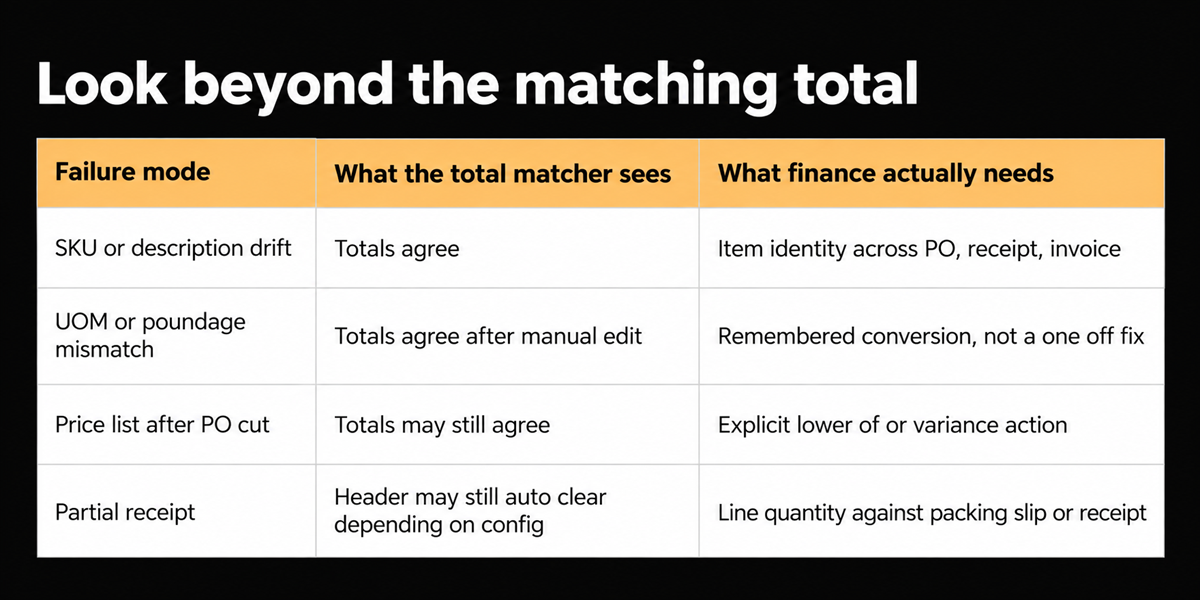
Ask the vendor questions while you are evaluating tools. Can match fail a line when the header passes. Can UOM conversions be remembered per vendor. Can a price list update change the payable price without rewriting the PO. If the answers are vague, assume you are buying a total matcher with better marketing.
What we built, and what we refused to pretend
We built item by item PO matching against linked purchase orders and packing slips, with room for unit conversion memory and variance actions, including lower of PO versus a later price list when that is the commercial rule. Staging shows linked purchase orders and packing slips on the invoice object, with line columns available on the PO side. The point of the product decision is not another explainer titled "what is three way matching." The point is that a green header is insufficient when SKUs disagree.
We refused to treat "totals match" as success. That is the deliberate choice. A tool that only clears on totals will always look faster in a demo and then recreate the poundage edit, the SKU argument, and the price list chase in production.
We also refused to promise that every edge resolves without a human. Quantity only POs without prices still need a quote or price source. Kickback to vendor rules at intake are only as good as the policy you write. UOM memory helps after someone teaches the first conversion. It does not invent your pack sizes from silence.
Who this applies to
This matters most if header totals usually clear and the real fights live on lines: SKUs, quantities, or packing-slip mismatches your team still reconciles by hand.
Where this does not help
If your POs are soft placeholders with no item detail, line match has nothing to grip. If you only care that cash out the door equals the PO total and inventory is someone else's system, header match may be enough for you. We are not trying to win that buyer with a feature they will turn off.
If government or highly constrained purchasing forces quantity only documents with prices living only in a separate quote process, treat that as a scoped workflow, not as magic matching. We would rather name the gap than fake a price.
Back to the green header
The drywall invoice that tied at the header and lied on the lines is not a rare edge. It is what total only matching systematically produces. Match the items. Convert the units you already argue about. Decide the variance action before the bill posts. Then the green light means something a plant manager and a controller can both trust.
Frequently asked questions
**Is line level PO matching the same as three way matching?**
Three way matching usually means PO, receipt or packing slip, and invoice. Line level matching is the granularity inside that idea: each item, quantity, and price must reconcile, not only the document totals.
**What should happen when the invoice price is lower than the PO?**
That is a policy choice. Some teams take the lower price automatically when a current price list supports it. Others route a variance for approval. The matcher should expose the difference, not bury it inside a matching total.
**Do packing slips have to live in the ERP first?**
They need to be available to the match. In our model, packing slips can link on the same invoice object as the PO so the comparison is visible in one place during review.