An owner-operator at a food manufacturing company running QuickBooks Online with Fishbowl put the category mistake cleanly. Some tools are payment solutions. They do a sort of OCR tax read for ingesting invoices. That is not the same as AP automation. Managers should not be asked to approve garbage extracts.
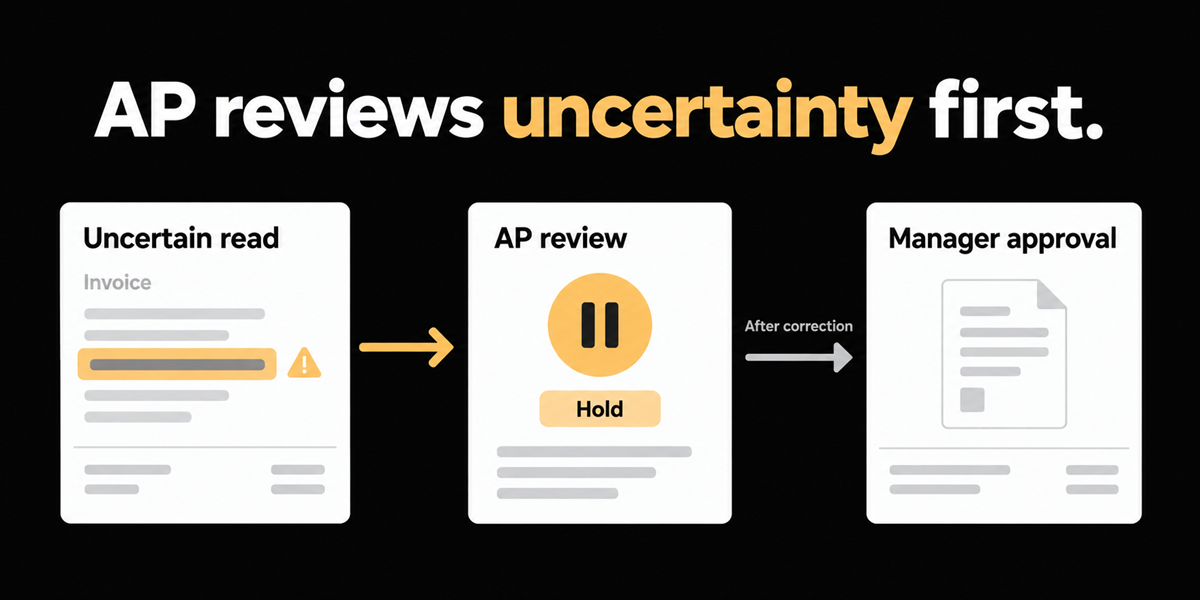
The direct answer: route uncertain reads to AP first. Hold low-confidence captures before a manager queue ever sees them. Payment speed is not a reason to launder bad data through an approval screenshot.
This matters most if you have evaluated payment-first products, if owners worry managers will rubber-stamp bad OCR, and if AP still exists as a real function even when headcount is small.
Payment tool versus AP automation
Payment products optimize disbursement. Capture is a means to get something into a pay queue. AP automation treats the bill as an object with lines, tax, match, exceptions, and audit history.
The second problem after buying a payment tool shows up in production. Extraction is shallow. Confidence is invisible. Managers approve because the amount looks familiar. Finance fixes the posting later, or does not notice until a vendor statement or a tax filing.
Food manufacturing adds ops edges: partial rejects and credit memos, vendor statements, multi-entity noise, and occasional needs like paying in currencies your bank stack hates. Those edges make shallow OCR more dangerous, not less.
Benchmarks for why holds are rational
Ardent Partners' Metrics That Matter in 2025 reports a 14 percent average invoice exception rate and 32.6 percent touchless processing, with average cost $9.40 per invoice. State of ePayables 2025 puts exceptions at 18.4 percent and straight-through at 35.4 percent depending on the survey. High exception volume is already the top operational complaint cluster in these reports.
A confidence hold is how you keep uncertain reads from becoming manager exceptions or, worse, quiet posts. Measure your own: share of manager approvals that Finance later reopens.
Confidence routing checklist
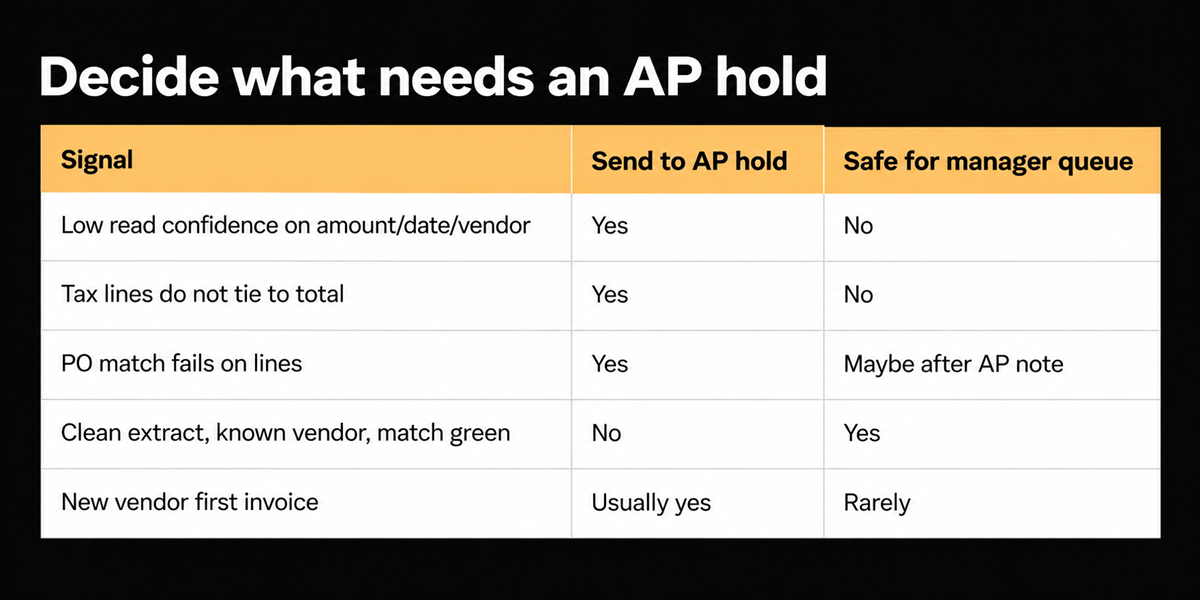
If your current tool cannot express the left column, managers are your filter. That is expensive filter technology.
What we built
We talk through uncertain-read holds that park questionable extracts with AP before manager approval. The design is quiet control: protect approver attention for commercial judgement, not for deciphering whether the OCR invented a total.
We refused the payment-product story that speed to disburse is the primary AP KPI. Speed matters. So does not training managers to bless bad reads.
Where this does not help
RMB and other uncommon payment currencies remain unmet for some buyers. Bank connections that drop into QBO are outside Finofo. Confidence thresholds need tuning per vendor mix; a hold rate that is too high recreates a bottleneck.
Deliberate choice: AP-first holds over maximizing manager throughput. We would rather a bill wait in AP than teach rubber stamps.
Back to the yogurt plant metaphor
Whether you make yogurt or machine parts, the rule is the same. Managers approve business. AP owns whether the document was read correctly. Hold the uncertain ones until that is true.
Tuning holds without creating a parking lot
Confidence routing fails in two directions. Too loose, and managers see junk. Too tight, and everything waits in AP until the close collapses. Start with high-risk signals: amount mismatches, tax math failures, unknown vendors. Publish the hold reasons so AP and managers share a vocabulary. Then widen or narrow thresholds with evidence, not vibes.
Language for managers when a bill is held
Holds fail socially when managers only see silence. A short reason code helps: tax math, vendor uncertain, amount low confidence, match failed. Managers learn that AP is protecting their time. AP learns which vendors create chronic holds. Without language, holds feel like blockade and get escalated politically instead of operationally.
Fishbowl, QBO, and the handoff problem
Food manufacturers often live across inventory and accounting systems. A payment tool that barely reads invoices will not heal a Fishbowl-to-QBO handoff. Confidence holds will not either. But holds keep bad extracts from becoming management theatre while you sort the system of record questions. Sequence matters: trustworthy bills first, exotic payment currencies later.
Owner-operators approve too much by default
In small food plants the owner is often the manager queue. That makes confidence routing even more important. The same person who cares about cash should not also decipher OCR. AP-first holds protect the owner's attention for vendor relationships and production issues.
Sample policy text for confidence holds
"Bills with low-confidence vendor, amount, date, or tax math stay with AP. Managers only receive bills AP has marked readable. Managers escalate commercial disputes, not OCR disputes." Put that in the approval policy document. Tools enforce. Policies explain. Without the sentence, holds look like obstruction.
Payment completeness is a separate requirement
Some teams need payment batches to include bills that never entered the AP inbox. Confidence routing does not solve that. Keep the requirements list honest so a strong hold story does not hide an unmet payment-completeness need.
Connect holds to vendor rules over time
Chronic holds on the same vendor should trigger a rule-writing session, not endless manual cleanup. Uncertainty that repeats is usually a layout or tax pattern you can instruct. Holds buy time. Rules spend that time on a permanent fix.
Why this is a quiet control design
Confidence routing is not flashy. It will not headline a homepage banner. It is still one of the clearest differences between AP automation and a payment wrapper. If a demo cannot explain where uncertain reads go, you are looking at a wrapper.
Closure metric for holds
Track median hours a bill spends in uncertain hold and the share that exit to manager versus return to vendor. If hold time climbs without rule writing, you built a parking lot. If manager-bound share falls while vendor returns rise, the control is working.
Who this applies to, restated
If managers currently approve shallow OCR from a payment product, or if owners approve everything themselves and resent deciphering extracts, this control is for you. If every bill already passes through a strong AP desk before any manager queue, you may already be practicing the idea under another name. Keep it, and ask vendors how they encode it.
One demo question that separates wrappers from AP
Ask: "Show me an invoice your model is unsure about, and show me who sees it first." If the answer is a manager, or if uncertainty is invisible, you are looking at a payment wrapper with OCR makeup. If the answer is AP with a reason code, you are looking at control design.
Frequently asked questions
Will holds slow payment?
They can. Measure days slowed versus dollars fixed. Many teams find manager rework was the hidden delay.
Is this the same as duplicate hold?
No. Duplicates are a specific exception. Uncertainty is about extract quality even when the invoice is unique.