A controller at a field services company with about 110 employees walked us through their monthly hotel and vendor statement ritual. The statement arrives as a long PDF. Dozens of pages of charges sit beside open invoices, credits, and payments that already live in Acumatica. Someone exports both sides into Excel, builds match columns, and spends the afternoon hunting for the lines that do not land.
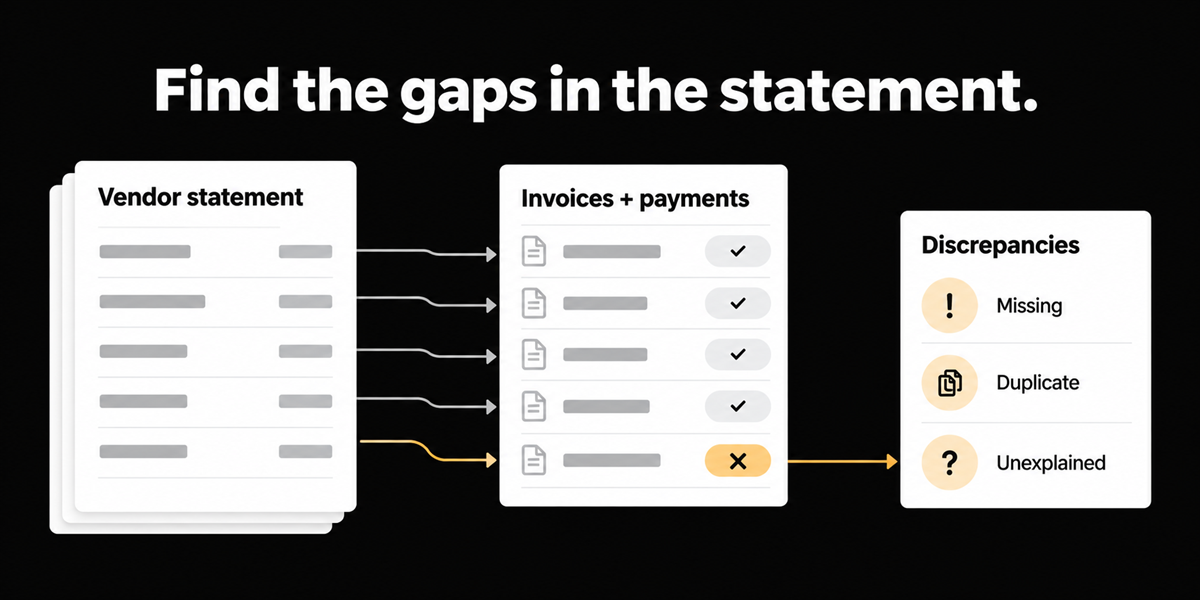
The direct answer is simple. A vendor statement is not an invoice. It is a control document. The work is matching every statement line to the invoices and payments you already have, then surfacing what is missing, duplicated, or unexplained so you can share a discrepancy view before lunch instead of rebuilding the same spreadsheet every cycle.
This matters most if you reconcile hotel or large vendor statements every month, if the PDF runs past a handful of pages, and if the current process lives in one person's workbook.
Why statement reconcile stays stuck in Excel
Invoice tools are built to capture a payable. Statements are built to prove that the payable ledger is complete. That second job looks similar on a screen, which is why teams try to force statements through the same capture path used for bills.
It fails in a predictable sequence. First, the statement has more lines than any single invoice, so header OCR is useless. Second, a matched line is not the same as a posted invoice. You need to know which open invoice, credit, or payment the line points to. Third, the useful output is the gap list: missing invoices the vendor expects you to have, duplicates sitting twice in the AP object, and amounts that do not explain themselves.
Hotel statements make the failure vivid. Folio lines mix room, tax, meals, parking, and incidentals. Controllers told us those packets are the reason statement work still opens Excel even when day to day invoices are already automated.
What the market numbers actually say
Ardent Partners' Accounts Payable Metrics That Matter in 2025 puts the average all-inclusive cost to process a single invoice at $9.40, with a touchless processing rate of 32.6 percent across surveyed AP organizations (US-heavy sample; treat as directional for Canadian mid-market teams). Statement reconcile sits outside that touchless share by design. The statement never becomes a bill. It audits whether the bills you think you have are the bills the vendor thinks you have.
APQC's Open Standards Benchmarking measure on duplicate or erroneous disbursements reports a median of 1.5 percent of annual disbursements. Statement work is one of the few places those duplicates show up before cash leaves, because the vendor's own list is the second source.
None of those benchmarks claim that a 300-page PDF finishes itself. They explain why missing the statement cycle is expensive even when individual invoices look fine.
A ten-minute diagnostic you can run this week
Pull last month's largest vendor statement and answer these questions without opening a new tool.
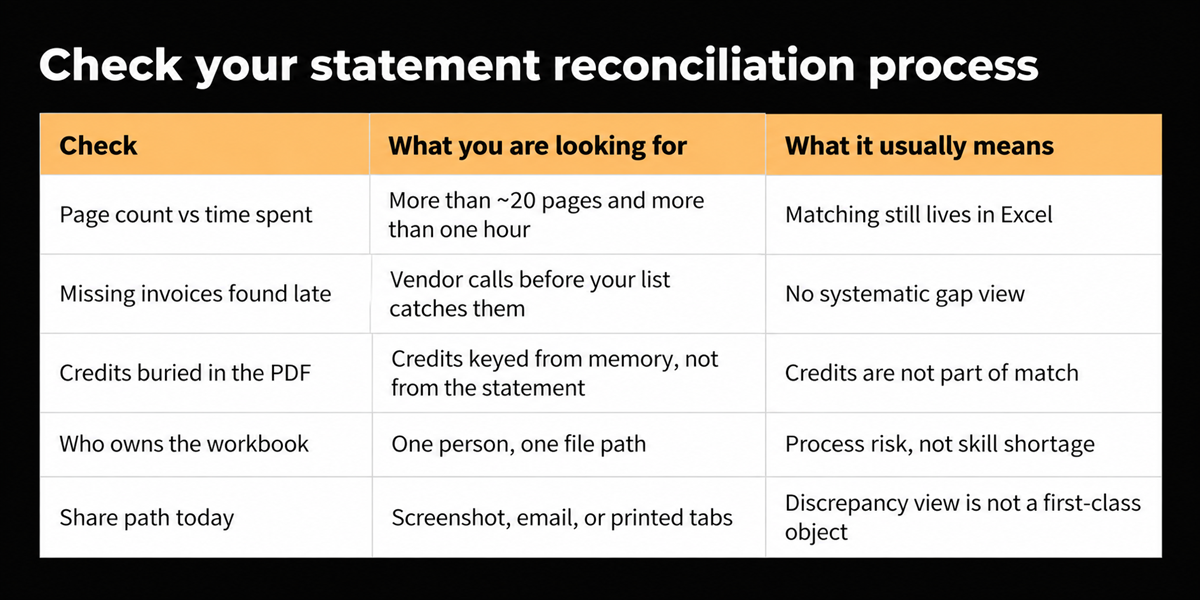
If three or more rows land on the right-hand column, the problem is not "we need better OCR on invoices." The problem is statement reconcile as its own workflow.
What we built, and what we refused
We built a Statements surface where you upload the PDF, extract every line, and match those lines to invoices and payments already in Finofo. Matched, no match, and explained states sit on the lines. Unresolved counts stay visible. Extraction rules can sit on the vendor for statement layouts that repeat. The useful artifact is a discrepancy view you can share, not a private spreadsheet.
We refused to treat the statement as another invoice to post. Collapsing a statement into one payable amount would recreate the exact Excel pain. We also refused a silent auto-close. When a line does not match, the system should leave it unresolved rather than invent a story.
In demos with field services, associations, metals, and manufacturing finance teams, the reaction was recognition more than theatre. Controllers already know the work. They want the match and the gap list inside the AP object.
Who this applies to
This matters most if vendor statements run long, credits and short pays are common, and matching still depends on one person who knows the vendor's layout.
Where this does not help
Dedicated statement products exist in the market. If your only requirement is a branded statement module and you do not care whether statements sit beside Canadian tax lines, multi-entity invoices, and the same AP object your clerks already use, shop that comparison honestly.
We also do not claim every exotic hotel folio layout arrives perfect on day one. Layout drift is real. Extraction rules need a human author the first time, and a refresh when the vendor redesigns the PDF. Credits and payments that never entered Finofo cannot be matched out of thin air. Payment completeness across bills that live only in the ERP remains a separate requirement some buyers raise.
Deliberate choice: statement reconcile is a control workflow attached to AP, not a free-standing analytics product. We would rather show matched and unresolved lines next to the bills than build a glossy dashboard that cannot open the invoice.
Back to the long PDF
The 300-page statement is not impressive because it is long. It is impressive because every page is a question about whether your books agree with the vendor's. Match the lines. Surface the gaps. Share the discrepancy view before lunch. Leave Excel for something that actually needs a spreadsheet.
How hotel and multi-page packets differ from a normal vendor PDF
A normal vendor statement is already long. Hotel packets add itemization chaos: room rate on one night, parking on another, a restaurant folio nested inside, taxes that look like fees, and credits that arrive as negative lines without a story. Controllers in field services named hotel statements specifically because Excel becomes the only place flexible enough to hold the mess, which is another way of saying the control has no home.
Multi-page metals and manufacturing statements create a different fatigue. The layout is more regular, but the page count alone turns matching into an endurance event. Either way, the AP object needs line status, unresolved counts, and a shareable discrepancy view. A private workbook cannot be the control of record for a company with more than one person in finance.
Sharing the discrepancy without screenshot theatre
The last mile of statement work is social. Someone has to show a vendor or an internal stakeholder what does not match. Today that often means exporting tabs, highlighting rows, and pasting a screenshot into email. By the time the reply arrives, the workbook has moved on.
A discrepancy view inside the statement record is useful only if another human can open the same object and see the same unresolved lines. That sounds obvious. It is the requirement most Excel processes fail, because the file path is the permission system.
Frequently asked questions
Is a vendor statement the same as a card statement?
No. A vendor statement is the supplier's list of invoices, credits, and payments on your account. A card statement is a bank or card network feed of charges. Both need reconcile, but the match targets differ.
What should I measure after changing the process?
Count pages, minutes to first discrepancy list, missing invoices found by you versus found by the vendor, and how many people can open the same gap view without asking for a file path.
Do you need every historical invoice in the tool first?
You need enough open invoices and payments for the statement period to be meaningful. A blank AP object will only confirm that nothing is there to match.