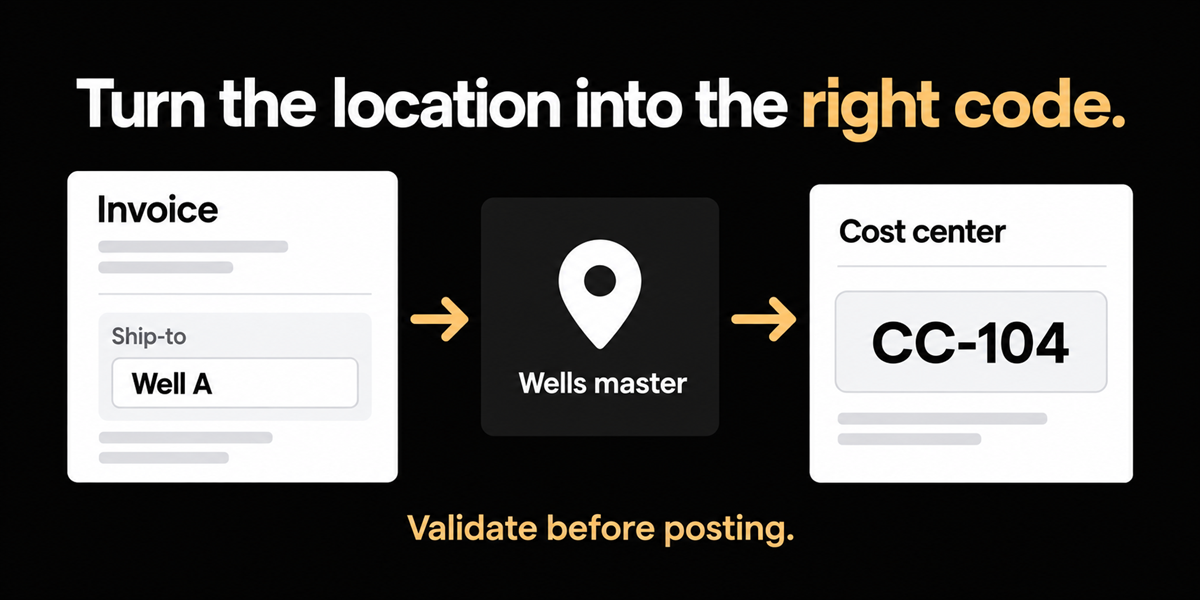
An oilfield drilling services company with five or six entities processes somewhere between ten and thirty invoices on a quiet day, more when rigs are turning. The ERP is QByte on IFS. Vendors print a ship-to or well location on the invoice. The cost center field is blank, wrong, or borrowed from the last job. The accountant already knows which well the truck actually visited. The document does not.
Ship-to text is not cost center coding. If your AP tool cannot cross check the location printed on the invoice against a wells master, someone will keep rekeying the real code by hand, every time a new vendor shows up with a slightly different description of the same pad.
This matters most if you code spend to wells, leases, or field locations; if multiple entities share vendors; and if the invoice print layout names a place while your chart of accounts needs a cost center.
The vertical depth US tools treat as a custom project
In one demo, a VP asked the question mid flow: when a new vendor invoice has the location but is missing the cost center, or the cost center is incorrect, can the system cross check and say what the cost center should be. That is not a nice to have for drilling services. That is how field spend becomes a trustworthy P&L.
Generic AP products treat this as project coding or a custom field mapping exercise. Oilfield teams already maintain a wells list. The work is not inventing a new dimension. The work is teaching the system that a legal description on a ship-to line means a specific cost center, even when the vendor typed punctuation differently than last month's vendor.
The second problem arrives after OCR gets better. Better capture of a wrong or empty cost center still posts a wrong or empty cost center. Reading the page is not the same as reconciling the page to master data. History based coding is equally shaky here, because the same vendor's prior invoice is often a different well.
External grounding on slow, ordinary invoices
Ardent Partners' Accounts Payable Metrics That Matter in 2025 reports an average cost of $9.40 to process an invoice and an average cycle time of 9.2 days across its survey of 212 AP professionals. Field invoices that require a human to open a wells spreadsheet sit in that average as ordinary effort, not as dramatic exceptions. They are slow in a boring way: look up the location, fix the code, hope the next vendor spells it the same.
Those Ardent figures are not oil and gas specific, and the sample is US heavy. Use them as a ceiling check. If your well coded invoices take a multiple of your non field invoices, the gap is the master data cross check, not keyboard speed.
A checklist you can run on last month's field invoices
- Count invoices where ship-to or location text is present but cost center was edited by AP.
- Count distinct location strings that map to the same well.
- Note how many new vendors in the period forced a first time mapping.
- Ask whether the wells master is updated in one system or copied into two.
- Write one plain language rule for your messiest vendor: if ship-to contains this location language, code this cost center under this entity.
If step 1 is routine rather than rare, resemblance based GL memory will not save you.
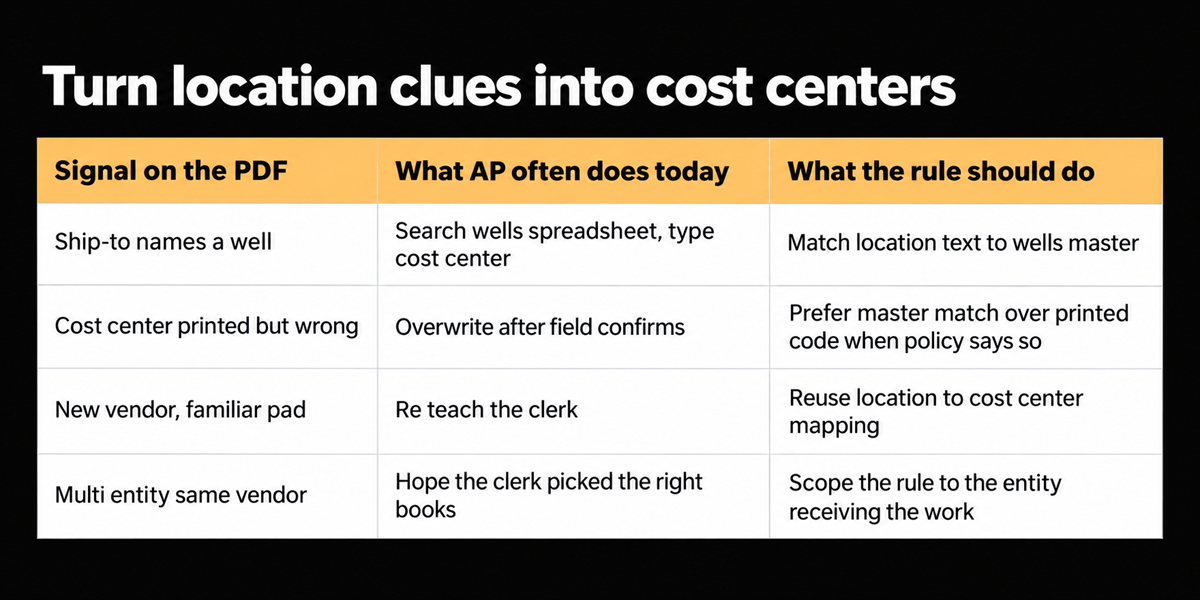
Vendor questions worth asking in a demo: show me a wrong printed cost center corrected by location match. Show me two entities sharing one vendor with different cost centers for similar text. Show me what happens when the location string is ambiguous.
One more structural fact shows up in multi entity oilfield groups: the same trucking or chemical vendor may bill three entities in a week. The ship-to language looks familiar. The cost center must still land in the entity that owns the well. Org context is part of the coding problem, not a login inconvenience.
What we built under that ask
We built plain language extraction and coding instructions that can use master data to map ship-to or well location text to a cost center, alongside the broader vendor rule pattern (whole document instructions and by field instructions). Staging verifies vendor extraction rules with those controls. Multi entity org switching is also verified, which matters when the same vendor bills five entities and only one of them owns that well.
The decision underneath is boring on purpose. We did not build a separate oil and gas module. We built instructable coding that can read a location and consult a list you already maintain. Vertical depth as configuration, not as a brochure industry edition.
We rejected the idea that resemblance based coding from prior invoices is enough. Prior invoices are often different wells from the same vendor. Resemblance without a location check is how cost centers quietly wander across the field map.
Who this applies to
This matters most if ship-to or wellsite text is reliable on the page but cost center, division, or AFE still has to be inferred by someone who knows the job.
Where this does not help
You still dual maintain a wells master if your ERP sync is flat file constrained. New vendors still need an instruction the first time their location prose is weird. If field tickets never make it onto the invoice and the only truth is a verbal from the lease operator, no invoice rule will invent the well.
We are also not replacing your AFE or joint interest billing system. Cost center on the AP document is the slice we automate. Full upstream accounting remains yours. That is a deliberate product boundary, not an accidental omission.
Who owns the mapping work
Finance can own the plain language rule. Operations often owns the wells list. If those two teams do not agree who updates what when a new pad comes online, automation will encode last month's map. Put ownership in the implementation notes the same week you write the first vendor instruction.
Close on the ship-to line
The well was on the page the whole time. The cost center was the part the vendor got wrong. Put the cross check in the workflow so AP is confirming a match to the wells list, not retyping geography into accounting codes under deadline.
Frequently asked questions
**Can the system override a wrong cost center printed by the vendor?**
Yes, when your rule says master data wins. That should be an explicit policy, not a silent rewrite with no audit trail.
**What if two wells have similar legal descriptions?**
Ambiguous matches should route to review. Automating a coin flip is worse than a short queue.
**Does this require the vendor to use your well IDs?**
No. The point is to accept the vendor's location language and map it. Expect punctuation and abbreviation drift.