A controller-side finance lead at a field services company connected two problems in one breath. About 110 employees. Acumatica. A small related second entity. Only a handful of corporate card users beside a larger reimbursable population. Invoice volume under two hundred third-party bills a month, which sounds calm until you watch the receipt chase.
Someone on the team was chasing people for receipts. After a client dinner, the fix they wanted was simple: take a picture and text it to a number.
In a separate manufacturing conversation on NetSuite with Float cards, the pain was sharper. Matching a receipt to a specific card charge meant manually telling the program which image belonged to which transaction before anything useful reached the ERP.
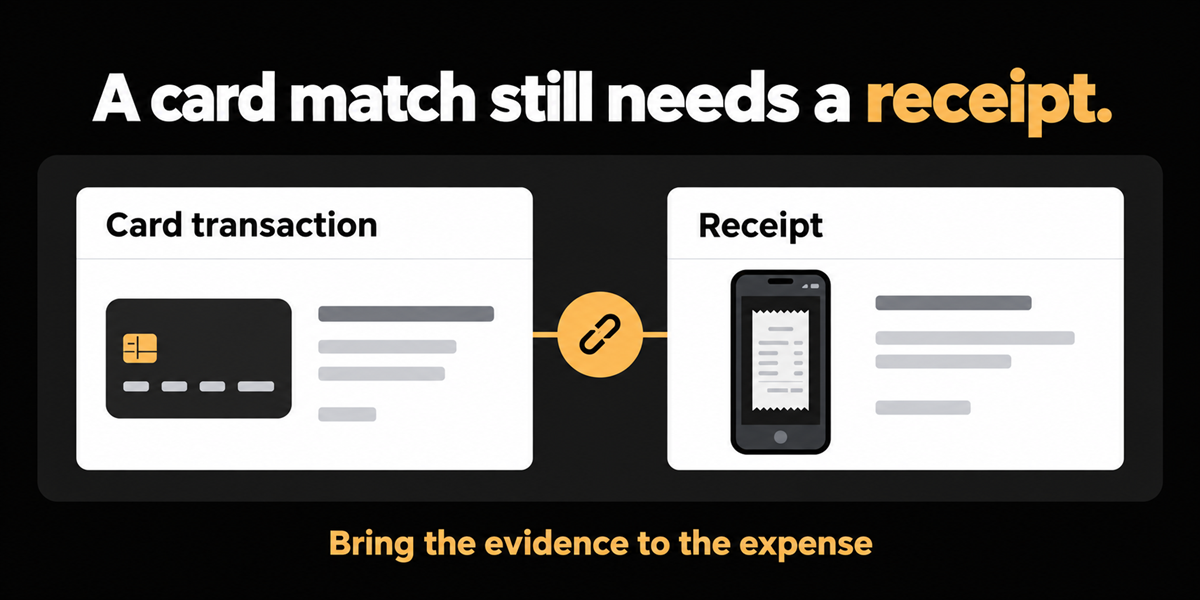
Short answer: a matched card feed without the receipt, or with a receipt that still needs a scavenger hunt, is only half a control. Finance still chases paper. The win condition is not "another matcher." It is receipt capture that lands in an AP-native expense object, with Canadian tax handled by finance, without forcing every cardholder through GL coding.
Who this applies to: controllers running corporate cards (Float or otherwise) plus field or mixed-tech employees, where receipt chase is the bottleneck and finance already reworks employee coding when apps force it.
Statement lines are not audit packages
Card products are good at showing that money moved. Audit and tax still ask what was bought.
A GBTA Foundation study with HRS (older, global travel-buyer sample; treat it as directional, not a 2026 Canadian census) found that 19% of expense reports contain errors or missing information, and that attaching receipts was among the most troublesome early steps for travel buyers (37% overall; higher for teams processing without third-party software). The receipts problem is not new. Card feeds did not retire it.
Canadian mid-market teams add another layer. Dual tax, tip lines, and entity coding are finance work. If the only path to attach a receipt is an employee app that also demands coding, you recreate the adoption failure we hear across wholesale and veterinary demos. People will not sit in the app. When they do, finance fixes the codes anyway.
Landscape honesty matters here. Float's public help material now documents automated receipt matching by merchant, date, and amount. We are not publishing a claim that we beat Float at Float matching. Buyers who already live in Float may also refuse a second receipt UI for cardholders. Those are real constraints, and pretending otherwise would waste a sales cycle.
A distribution team on SAP Business One said the quiet part out loud: cardholders are used to Float, and leadership was hesitant to introduce another thing on top of Float for the card user. Any AP-native path has to respect that friction or it dies in change management.
What we built instead of a matcher slogan
We pull card transactions into Finofo card expense surfaces and match receipts that arrive by SMS or email, including FX-aware cases where a USD charge meets a CAD card. The receipt becomes part of an AP-native object so coding, Canadian tax, and approval can happen where payables already happen.
The employee path we argue for is deliberately thin. Text a photo. Finance owns GL and tax. That is the same design choice as our broader SMS expense stance, applied to the card chase.
Staging verification for readers and for ourselves: Card expenses, card statements, and transactions surfaces exist, including Settings > Cards with a masked CAD card in the sample environment. Matching records were empty at check time. SMS and text receipt capture was not found in staging search. We lean on product demos for the SMS and match narrative and flag the staging gap rather than invent a screenshot we did not see.
What we refused: winning a bake-off solely on "we auto-match too." Matching is table stakes in 2026. The differentiator we will defend is AP-native handling plus Canadian tax plus finance-owned coding without an employee GL homework assignment.
Run this on your next statement cycle
Pick the last statement period for five active cardholders. Track four numbers.
1. How many transactions still lacked an itemized receipt at close.
2. How many minutes finance spent chasing those five people.
3. How many receipts arrived with wrong or missing tax coding when employees tried to help in an app.
4. Whether dual-tax or tip receipts were reworked by AP.
If (1) and (2) dominate, you have a capture-channel problem. If (3) and (4) dominate, you have a who-codes problem. Many teams have both.
Questions for vendors, written down before the demo:
- Can the receipt arrive without the employee touching the chart of accounts?
- Does the matched expense support GST/HST and PST/QST the way your AP invoices do?
- If we keep our card program, can receipts still land in AP without a second employee UI war?
- What happens on USD merchant charges against a CAD card statement?
If the answers collapse into "employees love our app," you already know the field outcome for a non-tech-savvy crew.
Where this does not help
We will not tell you to rip out a card program solely because receipt chase hurts. Card choice involves rewards, controls, and treasury. Receipt capture should not pretend to be a full issuer strategy.
We also will not promise that every Float-uploaded receipt image automatically appears in Finofo without integration work. Buyers asked. Certainty belongs in an implementation plan, not a blog boast.
SMS does not teach policy. Alcohol rules, missing merchant detail, and lost-receipt declarations still need finance judgment. Easier capture is not automatic compliance.
And if nobody sends the photo, the queue stays empty. The channel is easier. Accountability for getting the receipt in still belongs to the team.
The dinner receipt is the emblem, not the only case
Client dinners get mentioned because everyone understands them. The same chase shows up on fleet top-ups, airport wifi, small tools, and hotel folios that never make it out of a jacket pocket. Field services teams feel it daily. Manufacturers feel it when a small Float population still consumes outsized controller time.
If your close checklist includes a line item called "chase card receipts," you already priced the problem in labor. The software question is whether capture can meet the card feed without relocating accounting onto employee phones. If the answer requires a training curriculum, you chose the wrong channel for your workforce.
FAQs
Are you saying Float cannot match receipts?
No. Public Float help now describes automated receipt matching. Our point is different: AP-native objects, Canadian tax, and finance-owned coding without making cardholders become accountants on their phones.
Does SMS replace email forwarding?
No. Email forward remains useful for people who already live in inbox. SMS is for the people who will not open another app after dinner with a client.
Close
The card can match and finance can still be chasing the receipt. End the chase with a photo channel people will actually use, then do the accounting in AP. That is the whole plot. Matching alone never was.