A corporate controller supporting thirteen Xero entities worldwide described the daily tax on attention. Multi-currency. Provincial sales tax scars from a prior tool. Payment batches large enough that a 10 percent fail rate hurts. Underneath the dramatic failures sat a quieter one: switching organizations in some tools resets sessions, forces logouts, or pushes people into incognito windows just to keep two subsidiaries open.
Oilfield and real estate buyers told parallel versions with five to ten entities. NetSuite subsidiaries just gone live. QByte or IFS in the background. The pattern is the same. Controllers live in more than one set of books before lunch.
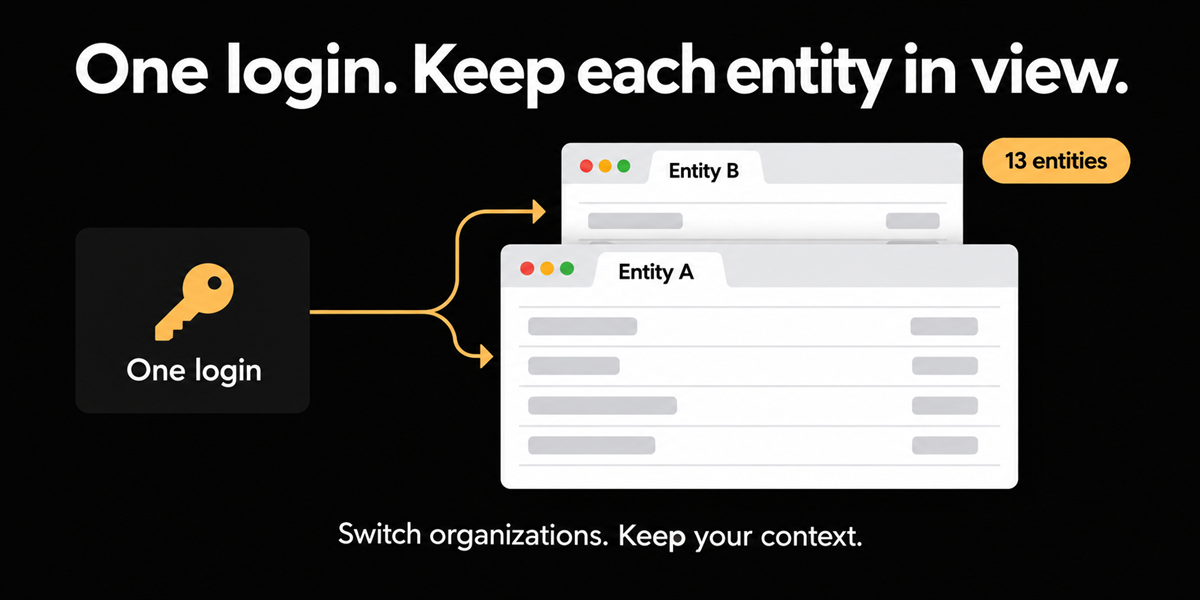
The direct answer: one login, an organization switcher, and parallel browser tabs that do not kick each other off. Multi-entity AP work is often simultaneous work. The session model should admit that.
This matters most if you have more than a handful of entities, if clerks bounce between subsidiaries in the same hour, and if your current tool makes org switch a context-destroying event.
Why org switch is not a settings footnote
Single-entity AP tools bolt on a company picker late. The picker changes data. It also quietly destroys the tab you were using for entity B while you approved entity A. People adapt with incognito, second browsers, and password managers. That adaptation is the product review.
The second problem appears after you buy "multi-entity" marketing. What you needed was parallel work. What you got was a dropdown that serializes your day. Cross-entity dashboards and APIs may still be on your list. They are not a substitute for being able to keep two tabs alive.
Benchmarks and the cost of fragmentation
Ardent Partners' Metrics That Matter in 2025 cites $9.40 average cost per invoice and 32.6 percent touchless processing. Those averages hide multi-entity drag: re-authentication, rediscovery of where an invoice sat, and duplicate vendor masters across books.
State of ePayables 2025 reports 8.2 days average to process an invoice and 21.9 percent of staff time on supplier inquiries. Controllers in multi-entity environments often spend inquiry time simply locating which entity owns the relationship.
Measure your own: minutes per day lost to re-login, and how many browsers a senior accountant keeps open as a coping mechanism.
Self-qualification and a quick test
If you answer yes to three of these, session design belongs on your scorecard.
1. Do people regularly work two entities in one sitting?
2. Does org switch today require logout, incognito, or a second profile?
3. Do roles differ by entity for the same human?
4. Do vendors repeat across entities with slightly different masters?
5. Did a prior tool win the demo on multi-entity and lose production on Canadian tax or FX?
Item 5 showed up with force in a thirteen-entity replacement story. Multi-entity comfort in a demo is worthless if line extraction fails later.
What we built
We ship an organization menu with multiple organizations, including paths to manage and create organizations, and a working pattern where parallel tabs can stay on different entities under one login. Roles can differ per entity. The point is uninterrupted context, not a slide that says multi-company.
We refused to treat multi-entity as only a reporting consolidation problem. Controllers need operational tabs, not only a year-end combined view.
Who this applies to
This matters most if you run more than a handful of entities and approvers still bounce between logins or browser profiles to clear a queue.
Where this does not help
This is not a substitute for Tipalti-class cross-entity AP dashboards or API asks buyers still raise. If your hard requirement is one glass pane across all entities with payment ops metrics, evaluate that honestly.
Vendor master governance across entities remains a deeper topic than a switcher. One login does not automatically dedupe thirteen masters.
Deliberate choice: fix the session and tab model first. We would rather you keep two live entities open than promise a mega-dashboard we do not have.
Back to the thirteen books
Thirteen entities is not a flex. It is a Tuesday. One login should be enough. The tabs should stay put when you switch. Save incognito for something that deserves it.
What "All organizations" is not
A menu entry that lists every entity is helpful navigation. It is not automatic consolidation, intercompany elimination, or a shared payment factory. Buyers who need those should put them on the requirements list explicitly. The incognito dance is a session problem. Consolidation is a design problem. Solve the first without pretending you solved the second.
Canadian production is the real multi-entity test
One thirteen-entity team had already lived the demo-to-production gap on a prior tool: convincing demos, then provincial tax and multi-currency pain in real life, plus payment failures at batch scale. Multi-entity navigation did not save them. Depth of extraction and tax handling did not arrive. When you score Finofo or anyone else, keep both scorecards: session sanity and Canadian document depth. Winning only one is how you buy another replacement cycle.
Roles per entity without shared confusion
The same human may be an approver in one subsidiary and a read-only reviewer in another. Session design has to carry role context with the entity, not assume one global permission set. When it does not, people escalate access until everyone is an admin everywhere, which defeats the purpose of separate books.
Subsidiary go-lives create a temporary hallway
Real estate developers mid NetSuite go-live still print and walk while seats and training catch up. Multi-entity login comfort will not retire paper alone, but session thrash makes the temporary hallway worse. Fixing tabs and switchers removes avoidable friction while extraction and approvals catch up.
Parallel work is the requirement statement
Write it into the RFP in plain language: "A user must be able to keep two entity sessions open in one browser profile without logout or incognito." Force vendors to demo it. Marketing pages that say multi-company support are not evidence. Watching two tabs survive an org switch is evidence.
Oilfield and tech share the pain differently
Oilfield teams bounce across entities when drilling spikes invoice volume. Tech hardware teams bounce across countries and currencies with large payment batches. The session requirement is shared. The document depth requirement diverges. Build your scorecard with both columns filled for your industry.
Implementation detail: names versus reality
Entity names in Finofo will not magically equal subsidiary names in NetSuite or Xero without mapping work. Plan a mapping workshop. Parallel tabs help daily work. Mapping prevents posting surprises. Both belong on the project plan beside the login demo that excited everyone.
What to measure after you fix sessions
Track re-login events per clerk per week, number of browsers or profiles in use, and time from "I need entity B" to first actionable screen. If those fall and document quality issues remain, you have proven the session was only one bottleneck. That is progress with honesty.
Frequently asked questions
Does All organizations mean consolidated posting?
No. Treat consolidated views and posting rules as separate design questions from session behaviour.
Can we mirror NetSuite subsidiaries one-to-one?
Buyers often want that mapping. Confirm it in implementation rather than assuming a name match is enough.