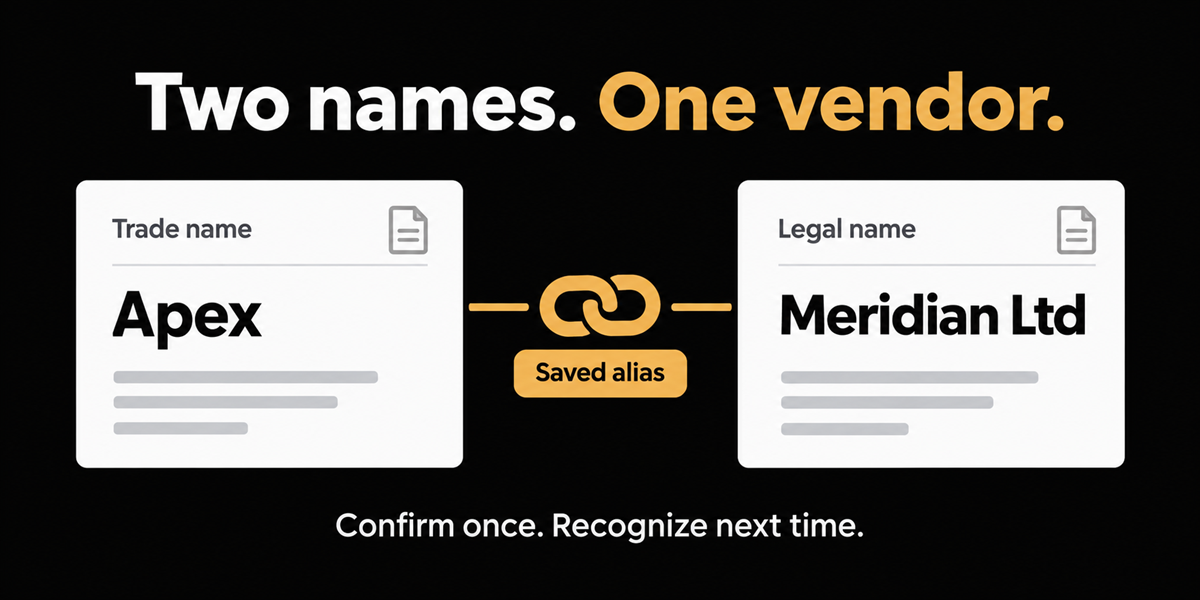
A senior accountant at a wholesale distributor with three entities described a clerk-time leak that never shows up as an exception metric. The invoice says a trade name. The vendor master in the DMS holds the legal name. Sometimes the legal name is a numbered company. OCR reads what is printed. Matching fails until someone teaches the system that both names are the same supplier.
The direct answer: save an alias once. Map the trade name (or numbered company string) to the legal vendor record. The next invoice that arrives under the trade name should recognize the vendor without another manual hunt.
This matters most if you buy from dealership-style or distribution vendors that invoice under brand names, if numbered companies appear on PDFs, and if clerks already keep a private sticky note of "who this really is."
Why vendor match breaks on names that humans already know
Humans resolve the mismatch in three seconds. Apex on the letterhead is Meridian in the master. The clerk has seen it forty times. Software without an alias table treats each string as a new supplier or a hard fail.
The second problem appears after you "fix" intake with a whitelist. Only approved vendors can enter. That is good control. It also means a trade-name invoice sits in a holding pattern until someone with master-data rights connects the strings. Without a teach-once alias, every occurrence is a ticket.
Dealership and wholesale demos surface this constantly. Parts invoices, tire and supply vendors, nursery suppliers, freight carriers that bill under a DBA. Tiny feature. Large clerk-time sink.
External grounding
Ardent Partners' Accounts Payable Metrics That Matter in 2025 lists invoice exceptions as a top AP challenge (53 percent of respondents in that report's challenge set) and puts the average exception rate at 14 percent. Vendor identification failures land inside coding and missing-information exceptions even when the amount is perfect.
APQC's median 1.5 percent duplicate or erroneous disbursements rate is also relevant: wrong-vendor payments and near-duplicate vendor masters are classic masters-data failure modes. An alias map is not fraud software. It is how you stop creating a second vendor because the letterhead used a different string.
These benchmarks are industry-wide and largely US-weighted. Your local measure is minutes per week spent asking "which vendor is this?" and how often a temporary vendor gets created to unblock a payment.
Teach-once checklist for your team
Use this table in a fifteen-minute AP huddle.
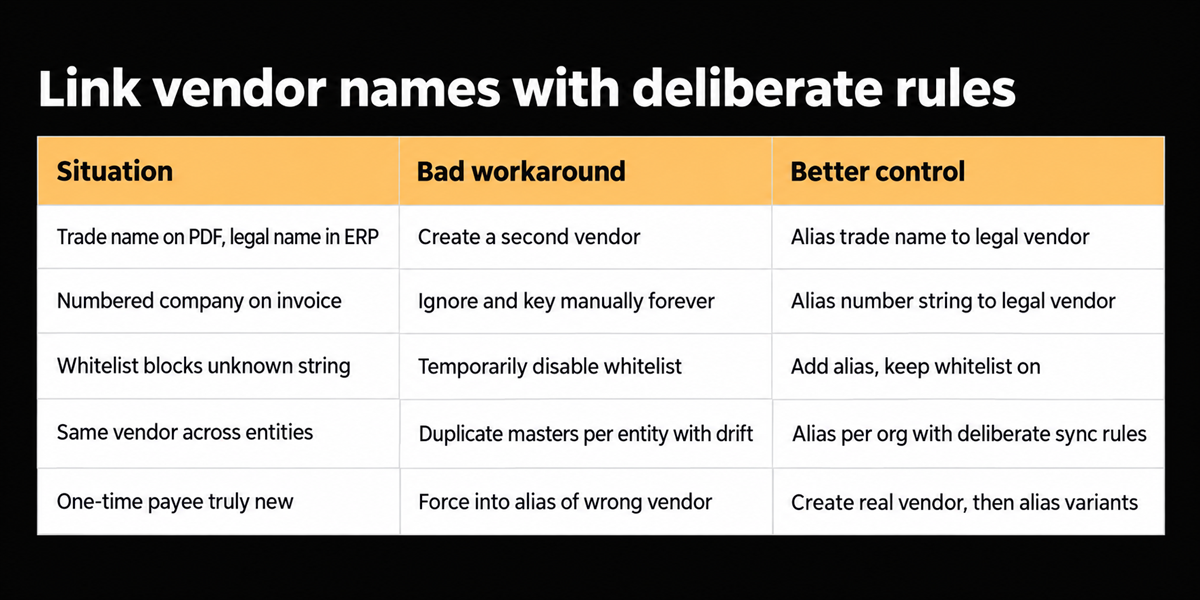
If your huddle cannot name who is allowed to create aliases, that is the first process fix.
What we built
Aliases are stored per organization and taught against the vendor master your DMS or ERP already trusts. The first occurrence still needs a human decision: is this the same supplier, or a new one? After that decision, recognition should follow the alias, not the clerk's memory.
We kept whitelist-controlled intake. Teaching an alias is not the same as opening the door to every unknown string. The deliberate design is teach once, keep control, stop re-litigating the letterhead.
We rejected fuzzy matching that auto-merges vendors without a human. Silent merges create worse master data than a failed match.
Who this applies to
This matters most if invoices arrive under trade names while your vendor master and remittance bank on the legal entity name.
Where this does not help
The first occurrence still needs a person. If your volume is dominated by true one-time vendors, alias value is lower than intake redesign.
Aliases also do not fix bank-detail fraud. Confirming a name match is not confirming a safe change to payment instructions. Keep out-of-band verification for banking changes.
Deliberate choice: human alias decision over aggressive auto-merge. We would rather ask once than invent a supplier relationship.
Back to the letterhead
The invoice will keep printing the trade name. The file will keep holding the legal name. Teach the link once. Let the clerk stop narrating it every week.
What clerks invent when aliases do not exist
Walk any AP pod for a week and you will see the workarounds. A shared spreadsheet of "real names." Sticky notes on monitors. Slack messages that say "use Meridian, not Apex." Temporary vendors created to unblock a payment, then never merged. Each workaround works once. None of them are controls.
The alias table is how you retire those workarounds without opening the whitelist. It is also how you stop teaching new hires a folklore map of letterheads.
Numbered companies deserve special care
Canadian and multi-jurisdiction vendors often invoice under numbered companies while operating under a brand humans recognize. Clerks learn the mapping. New hires do not. Creating a vendor master for every number string pollutes the file. Ignoring the number string and forcing the brand creates match failures.
An alias that connects "123456 Ontario Inc." on the PDF to the brand vendor your ERP already uses is unglamorous master data work. It prevents both pollution and false exceptions. Keep a short review cadence: aliases created this month, aliases unused for a year, aliases that point at inactive vendors.
Whitelist and alias are partners
Some teams fear aliases because they sound like a back door. The opposite is true when designed well. Whitelist says only known vendors enter. Alias says these strings are how known vendors identify themselves on paper. Disable whitelist to "just get the invoice in" and you recreate sprawl. Keep whitelist and refuse aliases and you recreate tickets. Teach both.
Dealership and wholesale patterns
Tire and supply distribution, nursery wholesale, and similar businesses see trade names constantly. The clerk-time cost is small per invoice and large across a month. Because each miss feels minor, it never becomes a project. Alias mapping is how you remove a thousand tiny hunts without a transformation program.
A thirty-day alias pilot
Pick the twenty vendors that generate the most "who is this?" messages. For each, capture trade name strings from the last three invoices and map them to the legal vendor. Keep whitelist on. Measure ticket count and time-to-match for those vendors before and after. If the count does not drop, your aliases are incomplete or clerks are still creating temporary vendors out of habit. Fix the habit with a simple rule: no temporary vendor without a finance lead approval.
Frequently asked questions
Does an alias change the legal vendor in the ERP?
It should not invent a new legal entity. It maps strings to the vendor you already maintain. Confirm how sync works with your DMS before go-live.
What if two real companies share a similar trade name?
Do not alias them together. Ambiguity is a reason for a human decision every time, not for a clever match score.
Can aliases differ by entity?
Yes in spirit: store them per organization so Canadian and US books can diverge when they must.