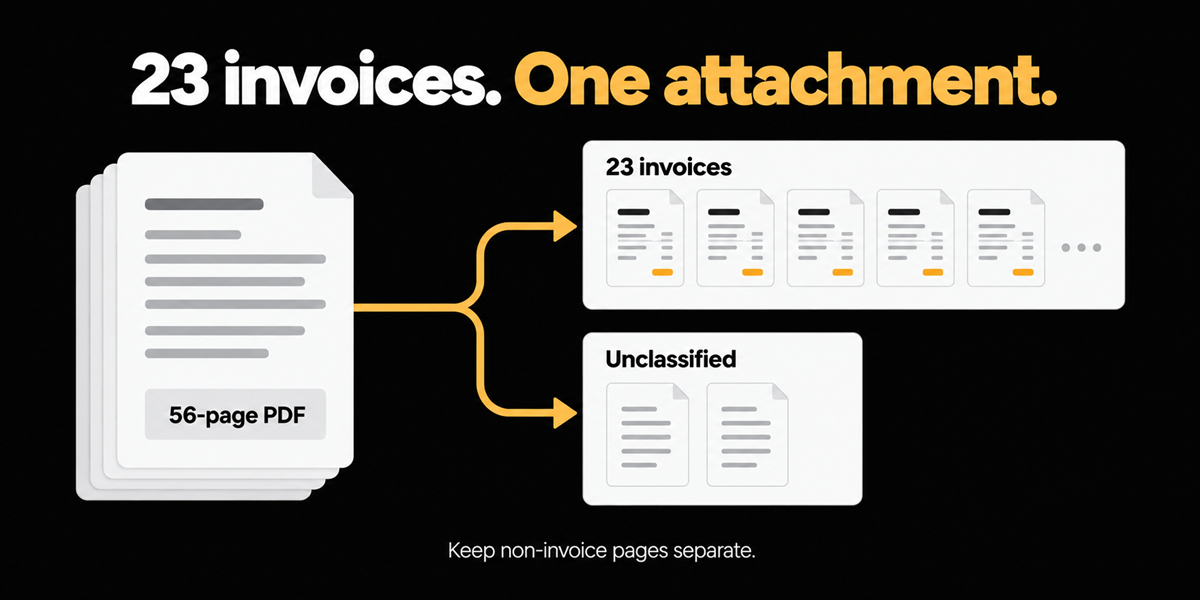
In product demos with restoration, nonprofit, and healthcare-adjacent finance teams, we keep returning to the same stress test. A client once sent a 56-page packet. Inside it sat twenty-three different invoices, plus appendix pages that were not bills at all.
The work was not "read page 1 carefully." The work was turn one attachment into twenty-three payable objects, and park the irrelevant pages where they cannot distort totals.
Short answer: compound PDF split is how AP scales when vendors refuse to send tidy single-invoice files. Classification matters as much as split. Non-invoice pages should land in Unclassified, not invent a twenty-fourth fake bill.
Who this applies to: controllers and AP managers who routinely receive multi-invoice vendor packs (services networks, healthcare operations, nonprofit programs, insurance restoration jobs) and still spend clerk time in Acrobat before coding begins.
Volume changes the failure mode
Five invoices in one PDF is an annoyance. Twenty-three in fifty-six pages is a staffing plan.
Each manual split is a chance to mis-order pages, duplicate a leaf, or lose a credit. Each re-upload is another inbox event. Teams that look fine at fifty invoices a month start to buckle when a single vendor billing run arrives as a book.
Clerks develop superstitions. Always start from the back. Always search for "Invoice #" as a delimiter. Always hope the appendix is at the end. Superstitions are not controls. They are how institutional knowledge hides operational risk.
Ardent Partners' State of ePayables 2024 reports that only 32.6% of invoices on average process straight-through, with a 14.0% average exception rate. A compound pack that enters as one confused object is almost designed to miss straight-through and to manufacture exceptions: wrong total, wrong vendor assignment, mismatched PO, duplicated pages treated as new bills.
This post is the scale twin of the five-invoice intake story. Same mechanism. Different magnitude. The demo wow is the before-and-after object count, not a slogan about AI.
What we built when the packet is a book
We classify pages, split multi-invoice PDFs into discrete invoices, and send unrelated appendix or cover material to Unclassified. Approvers then see real bills, not a binder.
Staging confirms the navigation: Unclassified, Invoices, Packing slips. Duplicate indicators exist when the same bill tries to re-enter after a messy pack is processed twice. Compound split ships.
We do not publish a guaranteed page ceiling. The 56-page / 23-invoice story is a stress-test narrative from demos, not a certified capacity badge. Split quality depends on invoice boundaries the model can detect. Handwritten or boundary-free packs still need humans.
What we refused: forcing every page into an invoice record to look fully processed. Full processing of junk pages is how you create junk payables. A green "100% classified as invoices" badge that ate an appendix is not a win.
We also refused to market split as the entire AP product. Twenty-three clean invoice objects can still be twenty-three wrong GL stories. Split is the on-ramp. Coding, tax, match, and approval remain the road.
Measure your own pack tax for two weeks
Tag every inbound email attachment that contains more than one invoice. Log four fields.
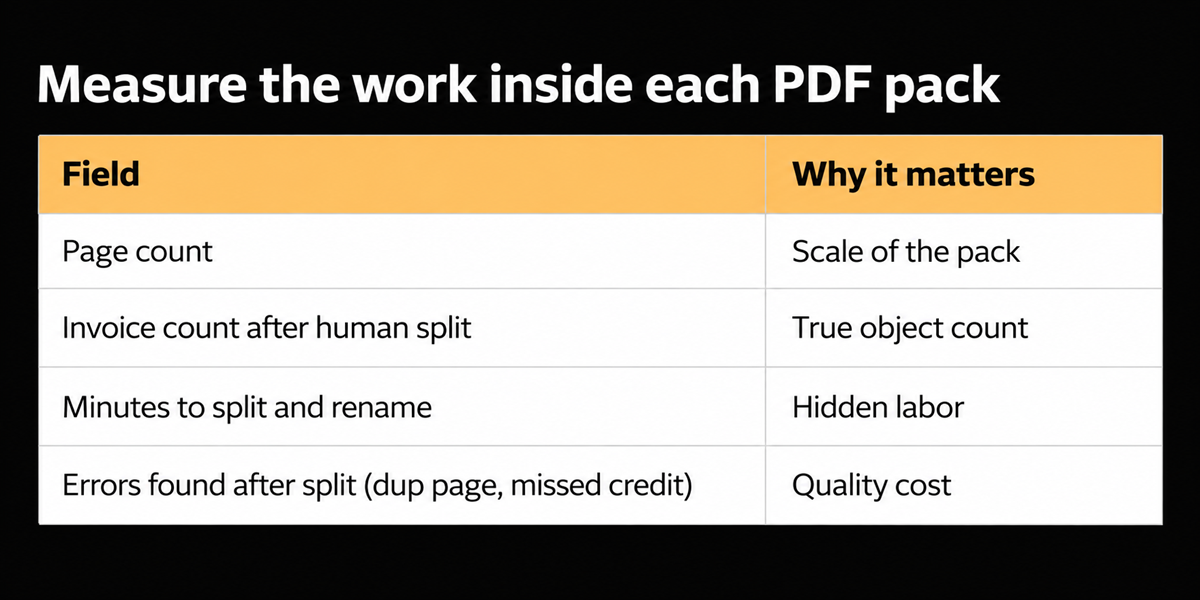
If minutes-to-split is material, your AP automation ROI model should include pre-software labor. If you never measure it, vendors will sell you extraction accuracy while your clerks still run the print shop.
Ask in demos: show a 20-plus invoice pack. Show Unclassified receiving the appendix. Show that each invoice total stands alone. Ask what happens when the same pack is emailed twice. If duplicate detection is a shrug, you will pay for split speed with double payments later.
For nonprofit and healthcare buyers, add one more ask: can supporting schedules ride along without becoming payable lines? Grant binders and clinical attachments are famous for this failure.
Where this does not help
We deliberately keep Unclassified instead of auto-posting mystery pages. If your team wants every leaf forced into a bill to clear a queue badge, we will disagree.
We also will not pretend split replaces PO matching, tax coding, or approval policy. Object creation is necessary. It is not sufficient.
Handwritten compound packs remain a review class. The honest product is faster, safer separation plus a place for non-invoice pages, not a claim that every scanner tray becomes touchless.
Excel workbooks that arrive beside the PDF may still sit unclassified until they are PDF. That limit is the same one we state on the five-invoice post. Consistency beats wishful marketing.
How this differs from "we support multi-page PDFs"
Multi-page support usually means one invoice that spans pages. Compound support means many invoices inside one file, plus pages that should never become invoices.
Those are different engineering problems and different buyer risks. A multi-page UPS bill that stays one object is fine. A 56-page binder treated as one object is how you invent a nonsense total and then spend a day untangling it.
When you evaluate vendors, force the distinction in the agenda. Ask for a multi-page single invoice demo and a multi-invoice pack demo as separate chapters. If they only show chapter one, assume chapter two is manual.
Restoration and nonprofit buyers should also watch entity routing after the split. Twenty-three invoices can belong to more than one job or fund. Split creates the objects. Your coding rules and dimensions still have to place them. Do not let a pretty split animation distract from that second half.
Finally, train clerks on Unclassified review the same way you train exception queues. Packets that produce a pile of unclassified pages are not "broken automation." They are doing the safer thing. Review the pile. Promote true invoices. Leave schedules where they belong. If Unclassified is ignored, packs will reintroduce the same binder problem one folder over. Make the review a named step in the SOP, with an owner and a daily glance, not an orphan queue nobody opens.
Bring one historical pack to procurement or ops and ask them to label each invoice number they expect to see. Use that labeled pack as the acceptance test when software vendors demo. If their split count disagrees with the labeled truth, you have your answer before any contracts are even drafted during this buying quarter.
FAQs
Is 23 invoices a supported limit?
We are not publishing a page or invoice ceiling. The 23-in-56 story is a demo stress narrative. Evaluate on your real packs.
Do unclassified pages disappear?
They should remain available as supporting material rather than vanishing. The point is keeping them out of payable totals, not deleting evidence.
Close
When one PDF holds twenty-three invoices, the first victory is counting to twenty-three correctly. Everything else in AP is downstream of that count. Get the objects right, then argue about coding quality on each real bill.