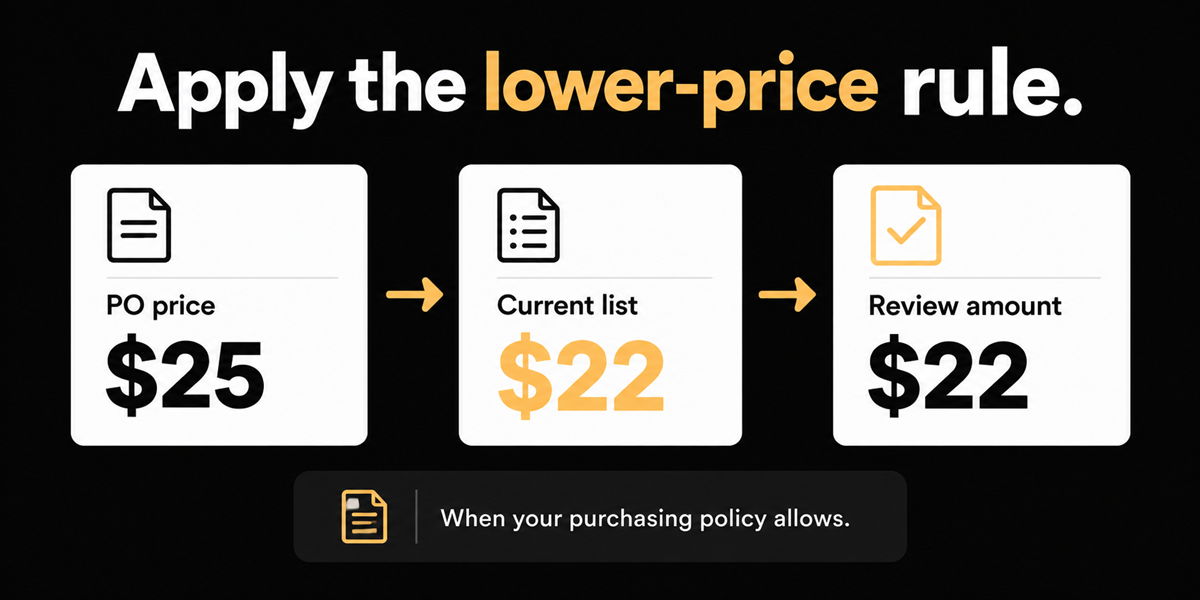
An operations and finance pair at a multi-entity construction materials manufacturer put the requirement in one sentence. They cut purchase orders. Then a vendor price list arrives with lower prices on some lines. They want to apply those lower prices, not politely overpay because the PO was earlier.
The direct answer: matching needs a lower-of rule between PO price and current price list, with line-level variance actions when the invoice disagrees. A total-only match that says "close enough" will bless the higher amount.
This matters most if you buy commodities or materials with volatile vendor price lists, if POs are cut in batches before lists refresh, and if procurement expects AP to protect the lower price without a manual rewrite of every PO.
Total match said yes. Line match said no.
Their incumbent could auto-match invoice total to PO total. That is a common ERP comfort blanket. It fails when one line is high, another is low, and the total still lands inside tolerance.
Price list timing creates a second failure mode. The PO was right when it was cut. The commercial reality changed. Paying the PO price is not loyalty. It is leaving money on the table the vendor already offered in writing.
Buyers also asked for front-end rules that kick bad invoices back to the vendor. Lower-of logic sits in that family: procurement policy expressed inside match, not as a spreadsheet after the fact.
What the benchmarks imply
Ardent Partners' State of ePayables 2025 reports an average invoice exception rate of 18.4 percent and 65.4 percent of invoices linked to a PO. Best-in-class teams post 11.1 percent exceptions and 84.0 percent PO linkage. Metrics That Matter in 2025 cites a 14 percent average exception rate in its cut, with best-in-class near 9 percent.
Price variances are a classic exception category. If your process resolves them by always paying the PO, your exception rate can look healthy while your unit economics are soft. Track two numbers: exceptions opened, and dollars left on the table when a newer vendor list was lower.
Line-level diagnostic for your next vendor list drop
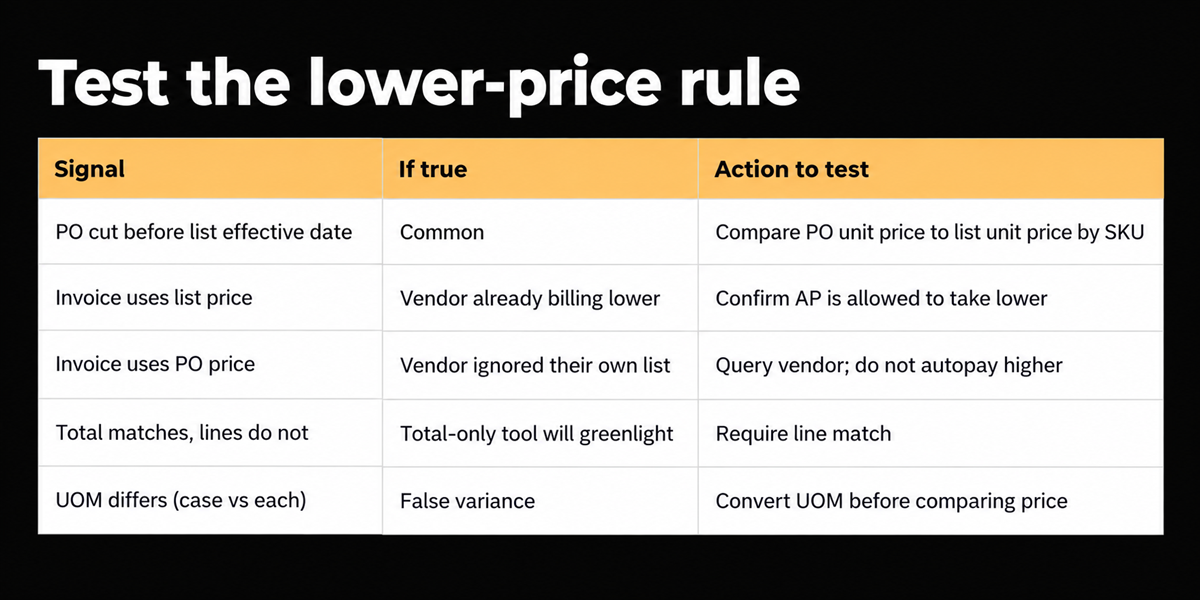
Run this on one volatile vendor before you rewrite policy globally.
What we built toward, carefully
Capability work here sits with line-level PO match, UOM conversion memory, and variance actions, including lower-of PO versus price list as a procurement rule buyers asked to apply. The design intent is clear: item by item, not total only; convert units before arguing about price; let a lower list price win when policy says it should.
Honest limit: price-list master data ownership is easy to underspecify. Who uploads the list, how often, and which entity it applies to must be explicit. We will not imply that a PDF price list emails itself into perfect match without that ownership.
We rejected tolerance percentage as the whole story. A 2 percent tolerance can hide a systematic failure to take the lower list price. Tolerance is a safety net. It is not procurement logic.
Who this applies to
This matters most if vendors issue price lists after the PO is cut and your rule is to pay the lower of PO and current list when the invoice arrives.
Where this does not help
If vendors never publish interim lists, and prices only move on new POs, lower-of is unused. Focus on clean line match and receipts.
If your ERP already owns price list match as a hard module and AP is only posting, confirm where the rule should live before duplicating it.
Deliberate choice: procurement-aware match rules over marketing that only says "we do three-way match." We would rather specify lower-of and variance actions than claim a generic match badge.
Back to the list that arrived late
The PO was honest when it was cut. The list is honest now. Pay the lower amount when policy says the list wins, and make the line say why.
Pair lower-of with UOM honesty
Materials buyers also fight unit of measure drift: case versus each, poundage versus plate count. Comparing prices before converting units creates fake variances and hides real ones. Line-level match has to normalize quantity basis before it argues about dollars. Lower-of on the wrong unit is still wrong.
Variance actions should be visible decisions
When invoice, PO, and list disagree, someone chooses: take lower, take PO, query vendor, short pay, or create a credit expectation. Hiding that choice inside a forced match teaches clerks to click through. Show the action on the line. Make it reportable. Over a quarter you will see whether lower-of is actually firing or whether people still rewrite POs by hand.
Who owns the price list file?
AP cannot apply lower-of against a list nobody maintains. Decide whether procurement, ops, or a vendor portal export feeds the list. Decide cadence. Decide whether the list is entity-specific. Write those decisions before you enable the rule. Otherwise you will blame match logic for a master-data vacuum.
Kickback rules sit beside lower-of
Buyers also wanted intake rules that send bad invoices back to vendors before they enter approval. Lower-of is one policy. Kickback on gross mismatch is another. Both belong in the match conversation because both are procurement logic living too late in Excel today.
Reporting the dollars protected
If lower-of fires, record the difference between PO price and paid price by line. Sum it monthly. That number is how you defend the rule to sales-driven stakeholders who fear "upsetting the vendor" by taking the vendor's own lower list. Silence makes the rule look optional. A dollar total makes it operational.
Line match versus three-way marketing
Published education already covers what three-way match is. This post is not that. This post is the procurement rule that shows up after match exists: when the list drops, who wins? If a vendor can only recite "we do three-way," keep asking about lower-of and line variance actions until you hear a specific answer or a clear no.
A sentence for procurement and AP to agree on
"When a vendor price list effective date is later than the PO and the list unit price is lower, we pay the list price unless a contract says otherwise." If procurement and AP cannot agree on that sentence, software will not invent alignment. If they can, software should enforce the sentence on the line.
Frequently asked questions
Is lower-of the same as a price tolerance?
No. Tolerance accepts a band of differences. Lower-of chooses the lesser of two authoritative prices when policy allows.
What if the invoice is higher than both PO and list?
That is not a lower-of win. That is a vendor overbill. Kick it back or open a variance action.