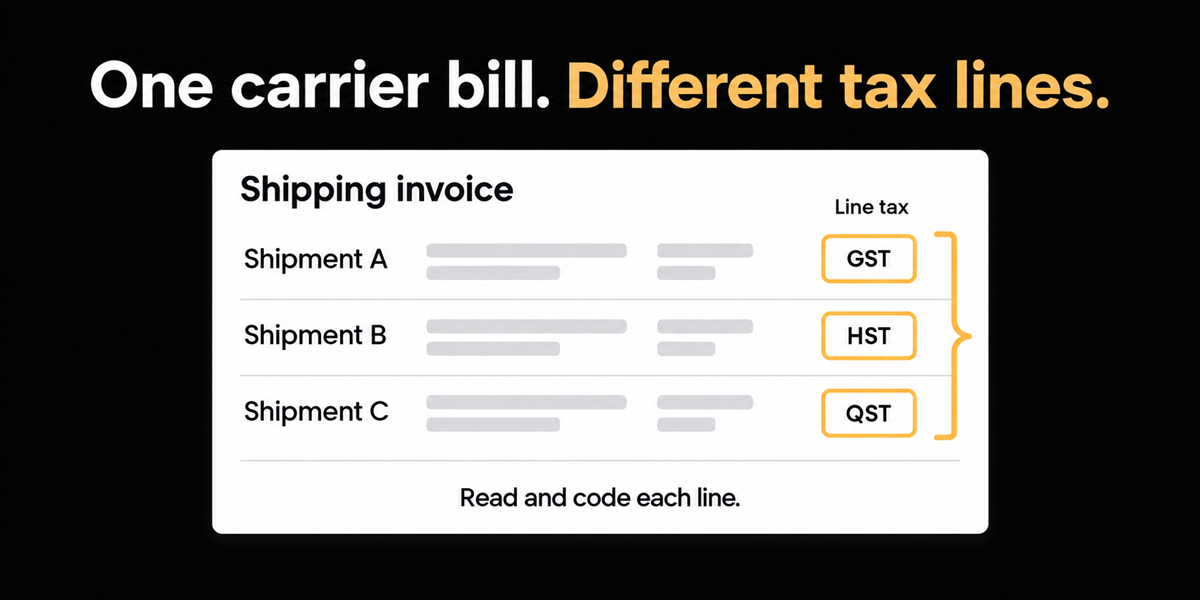
A finance lead at a NetSuite manufacturer said the major need out loud: process UPS billings and shipping invoices faster. A controller-level buyer on SAP Business One named the same class of document from another angle. UPS invoices are complex because they carry different tax codes and tax rates across lines.
The direct answer: a carrier invoice is a tax map. Header OCR that stamps one tax code on the whole bill will break Canadian recoverable tax and GL allocation. You need line-level multi-tax extract, plus vendor-specific prompts when internal codes on the bill mean something only your team understands.
This matters most if shipping is a top invoice volume driver, if you recover GST/HST/PST/QST carefully, and if finance already maintains a private decoder ring for carrier PDFs.
Why header tax fails on logistics bills
Carrier invoices mix services, accessorials, and jurisdictions. One line may be HST at 13 percent. Another may be GST only. Fuel and residential surcharges may need different GL treatment than the transportation line. Internal reference codes may encode cost centres your chart of accounts expects.
Header-level tools read a tax total and invent a single story. The second problem appears after the bill posts. Tax variance shows up in the ERP or in a year-end recovery review, when the clerk who understood the map has already moved on.
We heard the same pain from manufacturing and distribution teams evaluating other stacks. The vendor name on the demo slide changes. The PDF class does not.
Grounding numbers
Ardent Partners' Metrics That Matter in 2025 puts average invoice processing cost at $9.40 and touchless processing at 32.6 percent. Exception rate averages 14 percent in that cut. Carrier invoices rarely join the touchless share until line tax and coding are trustworthy.
Canadian context is stricter than a US sales-tax field. Recoverable input tax credits depend on getting the tax type right, not only the decimal. Our own staging samples show line-level treatments such as HST ON 13 percent with ITC commentary. Treat that as evidence that line tax exists as a product surface, not as a claim that every GST/PST/QST variant was sampled in one pass.
Carrier invoice readiness checklist
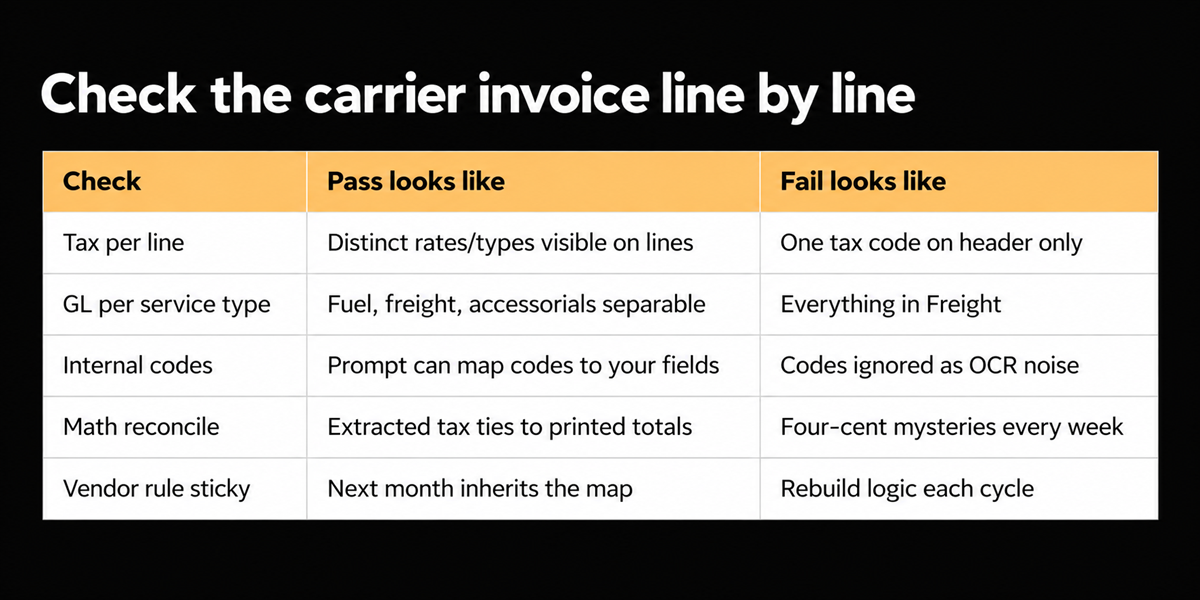
If you fail two or more rows, stop shopping "better OCR" in the abstract. Shop line-level tax plus vendor rules.
What we built
We extract at line level with multi-tax handling, and we let vendor-specific extraction rules capture the weirdness: internal codes, which columns matter, how to treat repeated layouts. The bill remains an AP object with comments and review, not a spreadsheet beside the ERP.
We rejected the idea that a carrier integration partnership is required to read a PDF you already receive by email. Formats drift either way. Rules need refresh when they do. Being honest about drift is better than selling a connector logo.
Who this applies to
This matters most if carrier invoices mix taxable and zero-rated lines across provinces and a single header tax code keeps failing audit review.
Where this does not help
This is not a carrier-account portal product. If your pain is downloading invoices from a website instead of receiving them, portal fetch is a separate unmet ask some buyers raise.
Rules need owners. When UPS or any carrier redesigns the PDF, someone updates the instruction. Auto-post without review is how quiet tax maps go wrong.
Deliberate choice: instructable line extraction over a branded carrier connector roadmap. We would rather your team encode the map than wait on a partnership announcement.
Back to the shipping PDF
The bill looks like one vendor. It behaves like many tax stories stapled together. Read it as a map. Code it as lines. Keep the rule on the vendor so next month does not start from zero.
Internal codes are not OCR noise
Many carrier and logistics bills print internal reference codes that mean something only inside your operation: a route, a customer shipment, a cost centre. Generic OCR keeps the string in a notes graveyard. Vendor prompts can promote those codes into the fields your P&L needs. That is the difference between reading the PDF and finishing the accounting.
Review habits that keep the map honest
Even with line extract and vendor rules, shipping bills deserve a light monthly audit. Sample ten lines across two invoices. Confirm tax type, confirm GL, confirm an internal code mapped as expected. When the carrier redesigns the PDF, your sample fails early instead of at filing season. Rules without a review habit become folklore again, just folklore stored in software.
Manufacturing and distribution both named the same PDF class
NetSuite manufacturing and SAP Business One distribution buyers, in separate conversations, pointed at UPS-like shipping invoices as the volume and complexity driver. That coincidence is the topic. When two ERP worlds name the same document class, you are not looking at an edge case. You are looking at a standing requirement for line-level tax and vendor prompts.
Math warnings are part of Canadian tax trust
When extracted totals and calculated totals disagree, the system should say so before posting. Four-cent mysteries are how clerks lose faith in automation. Faith matters because shipping volume is high. If clerks distrust line tax, they revert to header stamps and spreadsheet side calcs.
What to ask in a carrier-invoice demo
Upload a real redacted UPS-style bill. Ask the seller to show tax per line, not a header stamp. Ask them to write a vendor prompt for one internal code live. Ask what happens next month when the layout drifts. If the demo stays on a clean single-tax sample invoice, you have not tested the requirement that brought you into the room.
Pair with allocation rules when the bill is a dump
Some logistics vendors send spreadsheet-like detail that needs SUMIFS-style allocation rather than only tax mapping. That is a sibling topic: reading is not accounting. Carrier tax maps and lump-sum allocation often arrive from the same vendor family. Score tools on both, not on a single clean PDF demo.
Staging honesty on tax variants
Our staging checks saw line-level HST examples and calculation breakdowns. They did not exhaustively sample every GST, PST, and QST combination in one pass. That is a verification note, not a reason to keep header tax. It is a reason to test your provinces on your carriers during implementation.
Internal review before ERP post
Canadian controllers care about recoverable tax more than about a green OCR badge. Build a habit: shipping bills get a line-tax glance even when the vendor is trusted. Automation should shrink that glance, not remove accountability for ITC coding.
Frequently asked questions
Can one tax group on the vendor master fix this?
Only if every line truly shares that treatment. Carrier bills usually do not.
Do you need NetSuite or SAP B1 specifically?
No. The document class is what matters. ERP fit still matters for posting, but the tax map problem starts on the PDF.