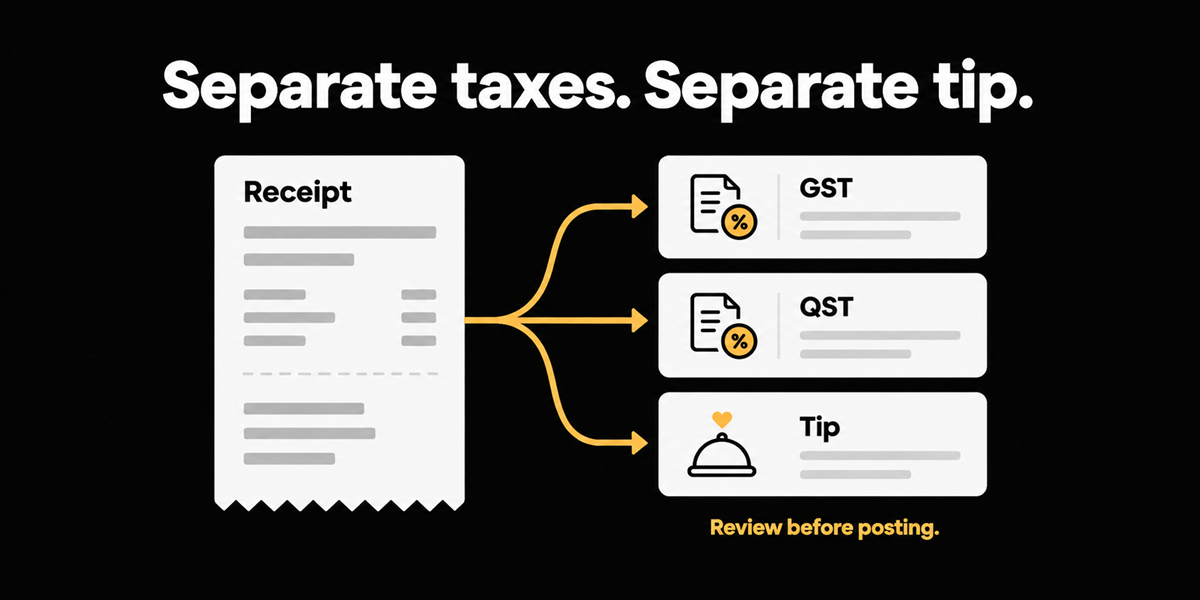
Ask any AP automation vendor to scroll to the tax block on a Quebec restaurant receipt. If GST and QST come back as two separate amounts, and the tip sits on its own line with no tax applied to it, the product was built for Canadian documents. If you get one blended tax figure, it was not, and you will find that out in month two rather than month one.
That test takes about fifteen seconds. It is worth running, because tax extraction is the failure that compounds most quietly. Invoices still post. Nothing errors. The variance surfaces later, at reconciliation, at filing, or when someone reviews input tax credit recovery and discovers the recoverable portion was never separated correctly in the first place.
The problem is not reading the tax. It is reading it as components.
Header level tax capture works fine on a clean, single rate document, and most AP tools clear that bar comfortably. The difficulty starts with documents carrying more than one tax.
A Quebec invoice shows GST at 5 percent and QST at 9.975 percent. Two separate taxes, different filing destinations, and for some entities different recoverability. A tool architected around a single national sales tax has one field to put them in. So it blends them, or it captures one and drops the other, or it captures the total and back solves a rate that matches neither tax.
Then there is the restaurant receipt, which is where tax logic tends to break quietly. The taxable subtotal is one number. The tip is another, and it is not subject to GST or QST. If the system applies the tax rate to the full amount including gratuity, every meal expense carries a small overstatement. Individually trivial. Collectively, a reconciliation exercise nobody scheduled.
Controllers who have been through this describe the same pattern. The demo looked fine, because the demo used a clean Ontario invoice with a single HST line. Production was Quebec, Saskatchewan, British Columbia, and a stack of restaurant receipts from a sales team.
What tax errors actually cost
Tax mistakes do not sit in their own bucket. They land in the exception pile, and exceptions are the most expensive thing in accounts payable.
According to Ardent Partners’ Accounts Payable Metrics That Matter in 2025, the average invoice exception rate is 14 percent. Top performing teams run at 9 percent. Teams without automation sit closer to 22 percent. The same research puts the average cost to process an invoice at $9.40 against $2.78 for best in class teams, and average processing time at 9.2 days against 3.1 days for top performers.
The gap between those columns is not keystroke speed. It is how much work never has to happen. An invoice that extracts cleanly and posts straight through costs a fraction of one that gets pulled out, investigated, corrected and re-approved. Ardent also found AP teams spend roughly 21.8 percent of staff time handling supplier inquiries, a figure that grows every time a payment goes out with the wrong tax treatment and a vendor asks why.
A blended tax field does not cause one exception. It causes an exception on every multi tax document you process, indefinitely, until someone rebuilds the mapping.
A fifteen second test you can run on any vendor
Bring three documents to the demo. Not the vendor’s sample data. Your own, redacted if you need to.
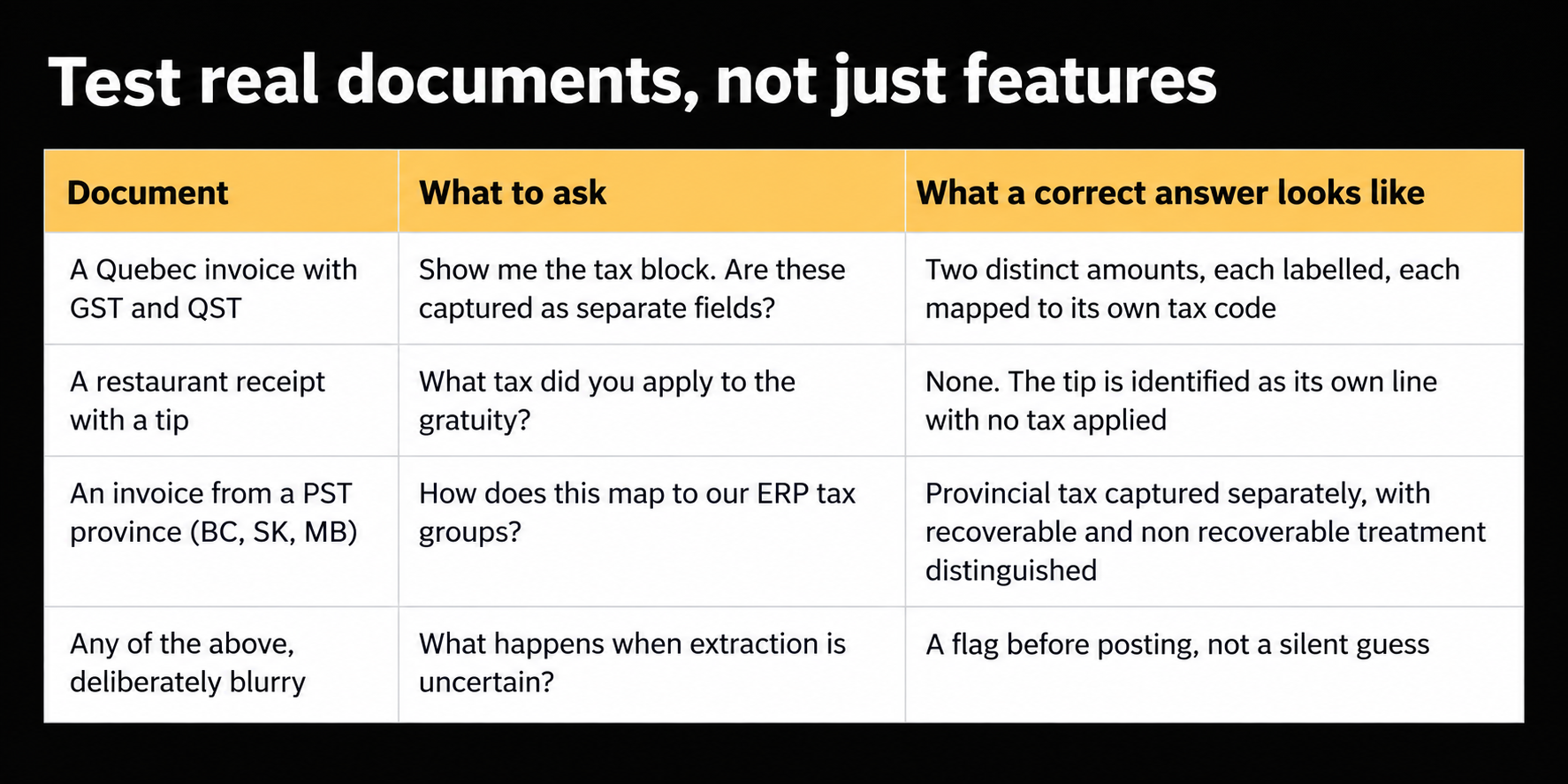
That last row matters more than the first three. A system that quietly guesses is worse than one that admits uncertainty, because you find the guess months later with no record of where it came from.
What we built, and where we drew the line
Finofo extracts Canadian tax at the line level, including dual tax documents, and keeps GST or HST separate from QST or PST rather than collapsing them into one field. On restaurant receipts, an identifiable tip is treated as its own line with no tax applied, so gratuity is not taxed.
The decision underneath that has less to do with tax than with where corrections happen. A tax error caught before the bill posts to the ERP is a short fix in a review queue. The same error caught after posting is a journal entry, an approval, and an explanation to someone. So variances surface before posting, and coding that was inferred by resemblance to past invoices is marked as inferred, because "the AI filled this in" should not quietly become "this must be right".
We also decided not to build a tax engine. Determining the correct treatment for a given transaction in a given jurisdiction is a different category of software, and pretending otherwise is how a vendor ends up confidently wrong at scale.
Where this does not help
If the tip is not legible on the receipt, we cannot infer one. An ambiguous handwritten total still needs a person to look at it.
If a document does not show dual tax, we will not manufacture QST to look thorough. Organisations with GST only status, or nonprofit rebate treatment, still need those rules configured explicitly. The default extract will not infer your tax status.
Line level extraction also does not replace your ERP tax setup. Tax groups, recoverable versus non recoverable treatment, and entity level defaults still have to be configured correctly. What changes is how much wrong data arrives at that configuration, and how late you find out about it.
None of this is tax advice. If your recovery position is genuinely uncertain, that is a conversation for your tax advisor, not your software vendor.
Back to the tax block
The reason to scroll to the tax block in a demo is not that tax is the most important feature in AP automation. It is that a vendor’s handling of Canadian dual tax tells you whether the product was designed for the documents you actually process, or adapted for them afterwards.
One blended field is an answer. It is just not the one you want to be living with in month two.
Frequently asked questions
Does AP automation software handle GST and QST separately?
Some does and plenty does not. Tools built primarily for the US market often have a single sales tax field, which forces GST and QST into one blended value. Ask to see a Quebec document during the demo and confirm two distinct, separately mapped amounts before signing anything.
Should tips be taxed on a Canadian restaurant receipt?
No. Gratuity is not subject to GST, HST or QST. Extraction that applies the tax rate to a total including the tip overstates recoverable tax on every meal receipt, which accumulates into a reconciliation problem rather than announcing itself as an error.
What is a normal invoice exception rate?
Ardent Partners’ 2025 research puts the average at 14 percent, with top performers at 9 percent and teams without automation nearer 22 percent. Tax mismatches are a recurring contributor because they repeat on every document from an affected vendor or province.