An HR and admin lead at a post-merger nonprofit with fewer than forty people described the current state without romance. Employees fill Excel expense forms. Receipts go missing. Someone says they will do it later. Payroll already runs through a separate system. The assumption hanging in the air was that employee reimbursements must hitch to that payroll connector to get paid.
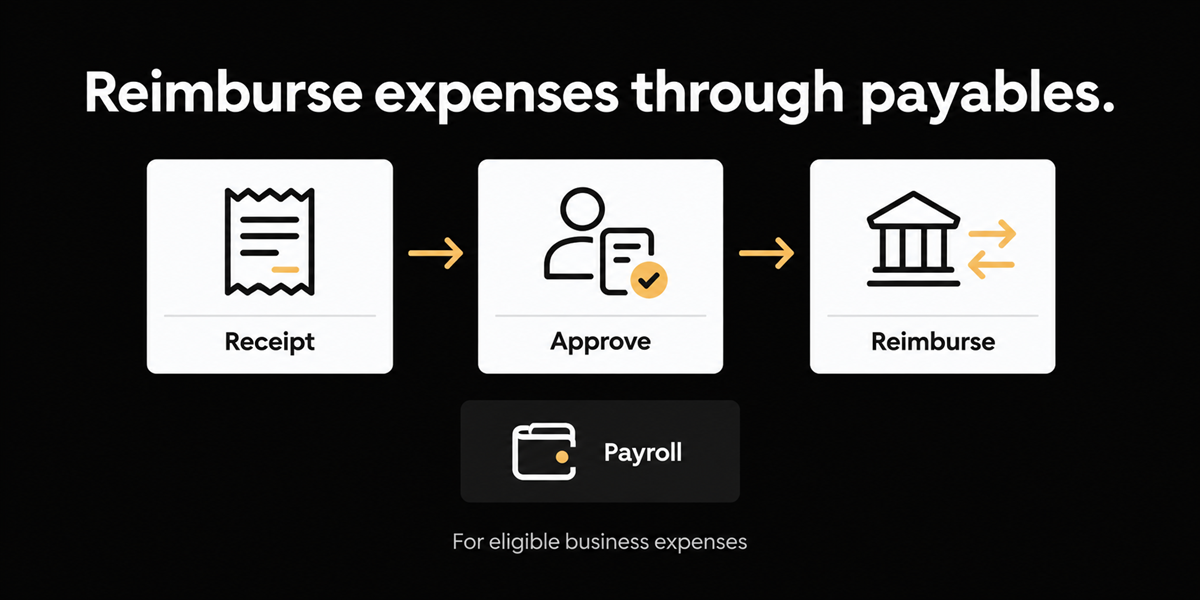
Then the aha: pay reimbursables as payables, separate from payroll. The reaction was immediate. That is something I have not thought of. It does make sense, and it is way better, actually.
The direct answer: accountable business expense reimbursements are usually payables with receipts, not payroll earnings. Riding them inside payroll confuses employees, mixes tax categories, and forces HR tools to pretend they are AP.
This matters most if you are a nonprofit or association on Excel expenses today, if HR owns the form but Finance owns the coding, and if you assumed a payroll connector was the only way to repay staff.
The second problem after "we will just add it to the next pay run"
Payroll is built for earnings, deductions, and taxable benefits. Accountable reimbursements for business expenses, when reasonable and receipted, are a different object in CRA guidance: a repayment of expenses incurred for employment duties, supported by records, generally not treated as income when they meet the conditions in CRA employers' materials such as T4130 and the travel expense topics on Canada.ca.
Stuffing those repayments into payroll creates practical failures even when tax theory is handled carefully.
Employees stop understanding the payment. Is this pay? Is this a benefit? Why does the net look weird next to my salary?
HR becomes the chase function for receipts that Finance will recode anyway.
Finance loses a clean AP audit pack: invoice-like receipt, approval, payment remittance.
Mergers make it worse. Check-based history, new legal entities, and a desire not to hire a pure AP role all push teams toward the familiar payroll button.
Benchmarks and why soft costs hide
The GBTA Foundation's expense reporting research is often summarized as about $58 and roughly 20 minutes to process an expense report on average (older GBTA Foundation study; still widely cited, so treat vintage as a caveat). Errors add more time. Whether or not your nonprofit matches that dollar figure, the shape is familiar: form setup, data entry, receipt attachment, manager sign-off, then Finance cleanup.
Ardent Partners' $9.40 average invoice processing cost (Metrics That Matter in 2025) is a cousin metric for the AP side. Reimbursements that become clean payables can inherit AP controls instead of inventing a parallel HR process.
Decision table: payroll vs payable
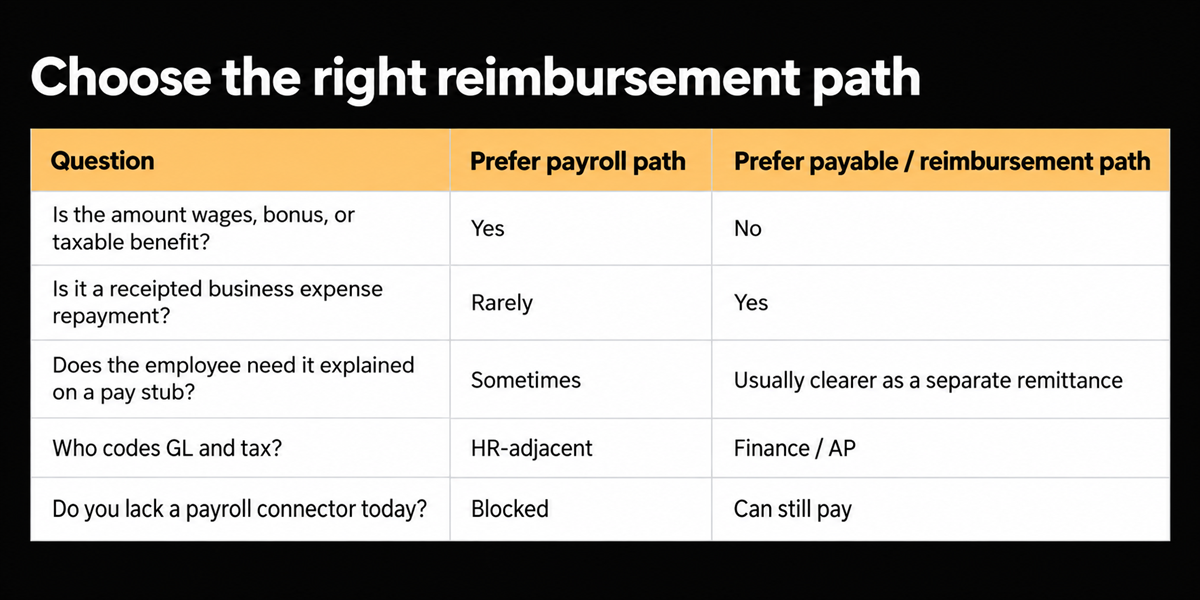
If most rows point right, stop waiting on a payroll integration to fix expenses.
What we built
We treat reimbursables as payables you can capture, approve, and pay from Finofo without requiring a payroll connector for the repayment itself. Receipt capture can be light for employees. Coding stays with Finance. Mileage and maps may sit in the same expense family when configured, but the design point of this post is the payment object: payable, not pay run.
We refused the assumption that employee repayment must wait on Nethris-class payroll linkage. Some teams will still want a single employee payment rail later. That is a connector ask. It is not a reason to freeze reimbursements inside Excel until the connector ships.
Who this applies to
This matters most if employee reimbursements ride through payroll and people cannot tell an expense repayment from a paycheque line.
Where this does not help
We do not currently offer that payroll connector. If your hard requirement is one combined employee payment through Nethris or equivalent, say so in evaluation and do not let a demo aha paper over it.
French employee UI was requested and is not a solved submitter experience in our notes. Sage version risk also appeared for this buyer profile. Those are real limits.
Taxable benefits and allowances still belong in payroll when CRA says they are taxable. Do not use AP to hide a benefit that should be on a T4. Read the CRA employers' guide categories; software will not forgive a misclassification.
Deliberate choice: clearer reimbursable payables now over waiting for a perfect payroll mesh. We would rather employees understand a repayment than force every receipt through a pay engine.
Back to the Excel form
The form was never the dream. The dream was employees getting repaid without turning HR into AP and without turning payroll into a receipt desk. Pay the reimbursable as a payable. Keep payroll for pay.
What employees actually understand
Employees rarely read payroll configuration. They read the money that landed and the label beside it. When a reimbursement is mixed into net pay, questions multiply. When it arrives as a separate remittance with a clear memo, fewer people ping HR asking whether they were underpaid. Clarity is an employee experience feature, not only an accounting preference.
Merger reality makes the aha sharper
Post-merger nonprofits often inherit check habits, Excel forms, and a payroll system that already feels heavy. Hiring a pure AP person feels like admitting the merge is unfinished. Paying reimbursables as payables lets a small finance team absorb volume without pretending payroll is a receipt warehouse. It also creates a cleaner handoff if you later add AP automation for vendor bills in the same package.
CRA categories in plain language for HR and Finance
Sit HR and Finance together for thirty minutes with CRA employers' guide categories open. Sort last month's employee payments into wages, taxable benefits/allowances, and accountable reimbursements with receipts. The sorting argument is the point. Tools should follow the sorting, not invent it. If a payment is taxable, payroll pathways remain. If it is an accountable reimbursement, AP pathways are available without waiting on a connector fantasy.
Avoid hiring for the wrong bottleneck
The nonprofit buyer said they did not want to hire a pure AP role again if they could avoid it. Expense chaos is not always a headcount problem. Sometimes it is an object-model problem: receipts living in Excel, repayments living in payroll, coding living in someone's head. Fixing the object model can remove the need for a hire that would only shuttle paper between systems.
French UI and connector asks stay on the table
Buyers asked for French employee experience and for payroll connectors. Those asks are real. Shipping reimbursable payables first does not erase them. It sequences them. Get employees repaid cleanly, then decide whether localization and payroll mesh are still blockers for your organization.
Receipt quality still matters
Paying outside payroll does not forgive missing receipts or personal spend mixed into business claims. Lost-receipt declarations, policy checks, and finance coding remain. The win is clearer payment objects and less category confusion, not a free pass on substantiation.
Frequently asked questions
Are all employee payments safer in payroll?
No. Wages and taxable benefits belong there. Receipted accountable reimbursements often belong in AP with documents attached.
Does this replace corporate cards?
No. Cards are a funding choice. Reimbursement is what happens when someone used personal funds. You may run both.