A corporate controller and an AP ops lead at a global tech and hardware company sat on a demo after living through a failed incumbent on Xero. Thirteen entities worldwide. Multi currency in EUR, USD, CAD, and AUD. Roughly two hundred payments in a batch, with about twenty to thirty failing every time, a ten percent fail rate they could feel in the week. The controller's line about the last tool was calm and damning: it looked good. The demos were convincing. Then you go through things yourself and realize it is not instantaneous.
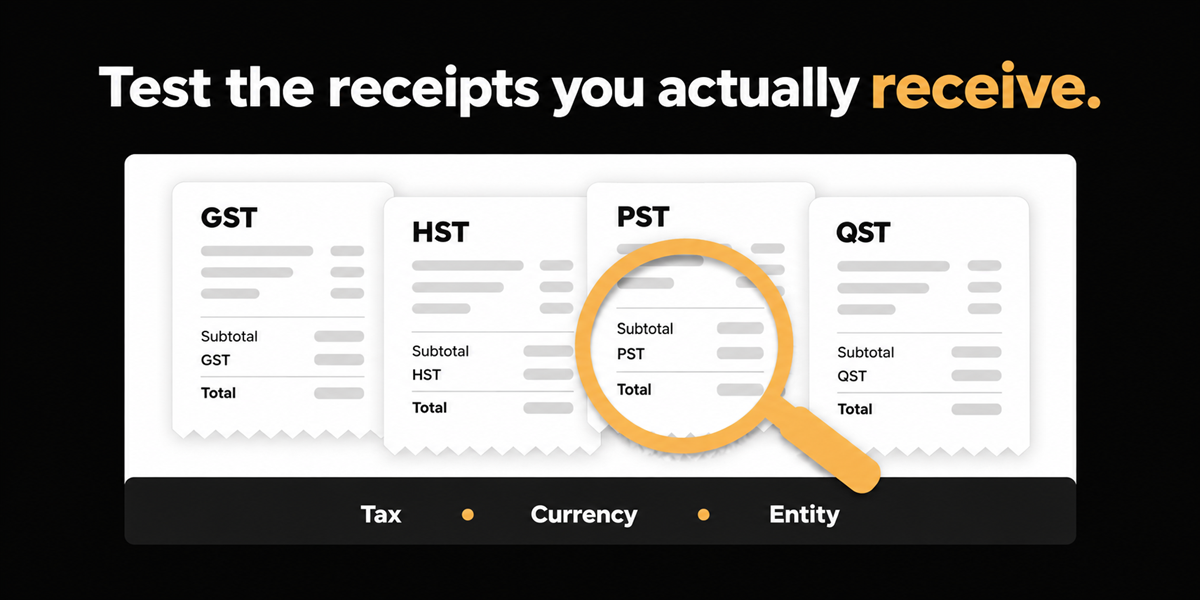
Canadian provincial tax and multi currency nuance are where US shaped AP demos go to die. If a vendor cannot show GST, HST, PST, and QST behaviour on real messy expenses and invoices, and cannot survive a two cent variance without locking a payment, the demo was theatre.
This matters most if you operate Canadian entities on Xero or another mid market ledger, if employees cross provinces on the same trip, and if you already scarred yourselves on a tool that sold AI and delivered line deletion.
What breaks after the polished walkthrough
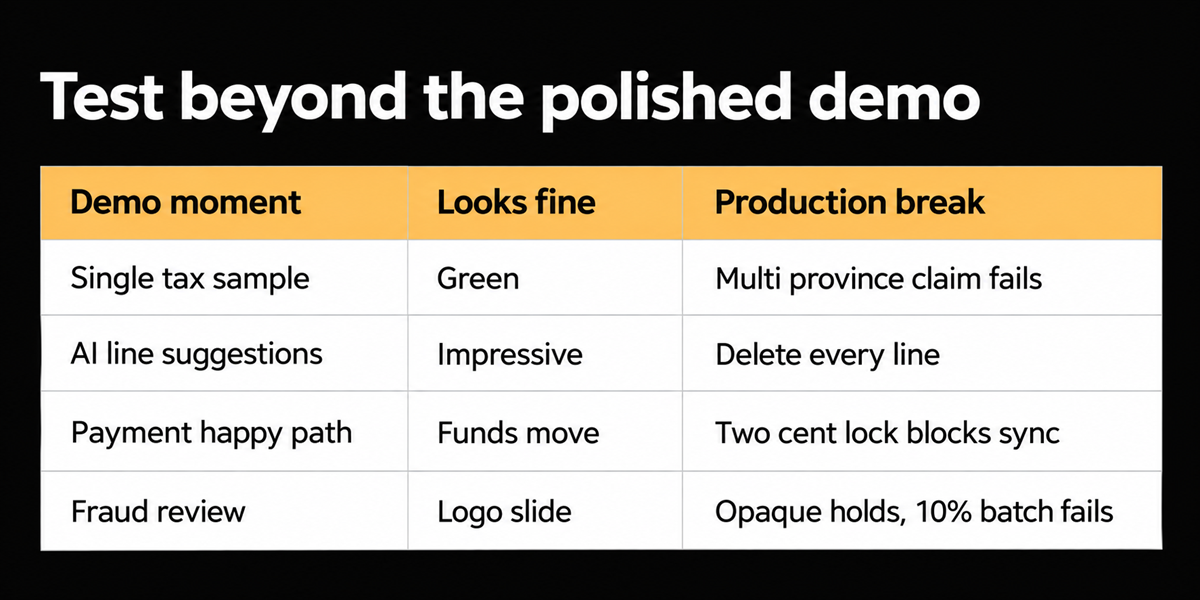
Front line AP described AI that created more work than manual entry: delete every generated line because the system could not figure it out. Controllers described provincial sales tax gaps on expenses with no credible roadmap. Ops described a two cent difference that locked a payment so it would not sync. Fraud holds arrived opaque. Multi currency was "supported" until the rate, the tax, and the entity disagreed.
None of that shows up in a happy path demo with one clean USD invoice and a single tax rate. The failure mode is specifically Canadian and multi entity: one expense claim with Alberta and Ontario receipts, a tip that should stay outside tax, a vendor bill with HST ON 13% beside a USD line that still needs CAD payable sense, a payment batch that must not freeze because of pennies.
The second problem is organizational. After a convincing demo, finance sells the project internally. Production pain then looks like user error. It is not. It is a quality bar the demo never had to clear.
Benchmarks and the cost of rework
Ardent Partners' Accounts Payable Metrics That Matter in 2025 reports average invoice processing cost of $9.40 and an average exception rate context in adjacent 2025 ePayables work around 18.4%. Best performers in Ardent's cost cohort sit at $2.78 per invoice, but that label is theirs, not a slogan we need. The relevant point for this story is rework. When AI lines must be deleted, you are paying the average cost plus a penalty for touching the same invoice twice. Canadian tax mistakes also create filing and recovery work that never appears in a touchless percentage.
The GBTA Foundation study with HRS (2015) found expense reports costly to process and correct, with 19% containing errors. It is an older, travel heavy dataset. Still directionally useful when your breakage is on expense tax across provinces rather than on PO match.
A demo script procurement should force
Do not accept the vendor's sample PDF. Bring your own.
- One multi province expense claim with at least two tax regimes and a tip.
- One Canadian vendor invoice with line level tax, not only a header tax blob.
- One multi currency bill where printed FX is slightly wrong.
- One payment scenario with a one or two cent discrepancy after partial edit.
- One duplicate or resent invoice.
Score each: did the tool extract correctly, did a human understand the exception, could you fix pennies without locking the world, and did anyone have to delete model output wholesale.
Sales enablement note for our own team, kept honest: this post is not a licence to bash competitors by name in customer meetings. It is a licence to insist on Canadian artifacts in the room. If a prospect will not share a messy document, offer a synthetic multi province pack and still refuse to end on the happy path slide.
What we position as the bar, without claiming perfection
We position extraction quality and Canadian provincial tax depth as evaluation criteria, not as a vibe. Staging shows line level tax breakdowns such as HST ON 13% with ITC context on sampled invoices, bill line math warnings, and currency reconciliation surfaces. Comments exist so tax arguments happen on the line. We care about whether GST and QST separate, whether tips stay zero rated, whether implied FX can be instructed per vendor.
We deliberately do not claim Finofo is immune to edge cases. That is the honest limit of this post. A quality bar narrative that pretends we never need review would repeat the competitor's sin. What we refuse to do is ship a US tax model with a maple leaf on the pricing page.
The product decision under the story: Canadian mechanics are not a localization pack. They are part of whether AP automation is usable here. If we cannot show them in staging and in demos with customer documents, we should not win the deal on animation.
Where this does not help
If your Canadian footprint is a single GST rate and no expense claims, you may survive a thinner tool. If your pain is pure procurement match with no tax complexity, read the matching posts instead. If you need us to promise zero exceptions on EUR nuances and every card feed edge, we will not. Measure us on the documents you actually pay.
Also: payment rail reliability and fraud review UX are related to this story but are not solved by tax extraction alone. Ask for batch failure rates in production references, not only in slides.
Who this applies to is narrow in a useful way: Canadian mid market finance teams who already bought a global AP brand once and are writing a sharper RFP the second time. If that is not you, borrow the demo script anyway. It travels.
Return to the convincing demo
The controller who said it looked good was not naive. The demo was designed to look good. Your job in evaluation is to make it look Canadian. Bring the provincial claim, the two cent variance, the tip, the wrong printed FX. Keep the tool that survives. Walk away from the one that forces your AP team to delete every line.
Frequently asked questions
**What Canadian tax cases should every AP demo include?**
Line level GST or HST, a dual tax case such as GST plus QST or GST plus PST, a tip that must not be taxed, and an out of province expense on a single claim.
**Is a two cent lock a tax issue or a payments issue?**
It is a workflow integrity issue that shows up at payment time. Tax and FX variance often create the penny. The system still needs a safe way to correct without freezing the batch.
**How do we avoid buying another convincing demo?**
Score vendors on your documents, in your entities, with your tax groups visible. Require a recorded session you can replay with finance and AP together.